

USGA Rule 14: What a Golf Ball Marker Is and Why It Matters
A golf ball marker is a small artificial object, like a coin or a purpose-made disc, placed behind or beside your ball to mark its exact spot on the putting green. You use it to lift, clean, or move your ball out of another player’s line, then set the ball back down exactly where it was. Rule 14 of the Rules of Golf spells out when and how you’re required to do it.
TL;DR:
- Using a proper artificial marker such as a coin, disc, or tee is mandatory before lifting your ball to avoid penalties.
- Markers must be placed directly behind or beside the ball and removed before making your stroke, with no natural objects allowed as markers.
- Magnetic or flat, low-profile markers are preferable in windy conditions for better stability and visibility on the course.
- Marking your ball when it is near another player’s line or upon request is essential, and forgetting to do so can result in stroke penalties.
- A ball marker is different from a ball mark, which is the small turf crater left by a landing ball and should be repaired promptly to maintain green health.
Table of Contents
- Why marking your ball correctly actually matters
- How to mark, lift, clean, and replace your ball step by step
- What the rules actually allow and forbid
- Choosing a marker that actually works on the course
- Etiquette and the mistakes that actually cost strokes
- Ball marker vs. ball mark: don’t mix these up
- Publisher perspective: small gear, big culture
- Sources
Why marking your ball correctly actually matters
The Rules of Golf define a “ball-marker” as an artificial object, a coin, a tee, a small disc, that you use to mark a ball’s spot before lifting it. That word “artificial” isn’t a throwaway detail. A leaf, a twig, or a pinch of sand won’t cut it. If you’re going to lift your ball, you need a real, man-made object sitting right behind or beside it.
Here’s why this matters more than it sounds like it should: putts are won and lost on inches. If your mark drifts even slightly, or you forget where you placed it, you’re not putting from the same spot you started. That’s not just sloppy play, it can turn into a rules violation.
You’ll see a handful of common marker styles on any given course:
- Standard coins (pennies and quarters are classics for a reason)
- Purpose-made plastic or metal discs, often flat and weighted
- Tees, in a pinch
- Divot-tool markers, which double as a repair tool and a marker in one
Pick one that’s small, flat, and easy to spot quickly.
How to mark, lift, clean, and replace your ball step by step
Marking your ball isn’t complicated, but the sequence matters. Skip a step and you risk a penalty you didn’t see coming.
- Place your marker directly behind the ball, touching it if possible, before you touch the ball itself.
- Lift the ball only after the marker is down.
- Clean the ball if you want to. This is allowed on the green, unlike most other spots on the course.
- Replace the ball in front of the marker, in the exact same spot.
- Remove the marker before you make your stroke.
If you need to move your mark out of someone else’s line, use a fixed distant point like a tree or flagstick, and count putter-head lengths to shift it for accuracy. Move it back the same number of lengths once it’s your turn again. Golf covers this putter-head method in more detail, and it’s worth committing to memory if you play a lot of group rounds.
Pro Tip: Pick a permanent landmark, not another player’s ball or bag, when you use the fixed-point method. Bags move. Trees don’t.
Get any of this wrong and the penalties are real: lifting your ball without marking it first, or making a stroke with your marker still sitting there, generally costs you a stroke, with additional consequences in stroke play according to golf rules every member should know if you end up putting from the wrong spot.
What the rules actually allow and forbid
The USGA and R&A don’t ask for much when it comes to markers, but what they do ask for is non-negotiable. Rule 14 requires you to mark your ball’s spot before lifting it, and to replace it on that exact spot afterward. Get either step wrong and you’re looking at a penalty, not just an awkward moment with your playing partners.
Almost any small artificial object works as a ball-marker under current rules, coins, tees, divot-tool markers, custom discs, but natural objects like leaves, twigs, or a pinch of grass are not permitted.
That guidance comes straight from USGA’s own explainer on ball markers, and it’s a rule that trips up more casual players than you’d expect. Grabbing a nearby leaf because you left your marker in the cart seems harmless. It isn’t legal.
There’s a second wrinkle worth knowing: markers with alignment lines. A simple line to help you set the ball down is fine, but a marker that functions like an alignment device, something that helps you read a putt rather than just mark a spot, can draw a penalty if it crosses into equipment restricted under the Rules. Regional rules pages, like the FSGA’s summary of ball marker rules, echo the same USGA and R&A guidance if you want a quick regional gut-check.
- Legal: coins, tees, purpose-built discs, divot-tool markers
- Illegal: leaves, twigs, sand, anything not man-made
- Restricted: markers doubling as alignment aids beyond a simple line
Choosing a marker that actually works on the course
Not every marker performs the same once it hits real turf, wind, and a fast green. Here’s what separates a good choice from an annoying one:
- Coins: cheap, always available, but thin coins can shift in wind or get stepped on
- Magnetic discs: clip to your divot tool or hat, stay put, and are easy to see
- Divot-tool markers: two tools in one pocket, efficient for pace of play
- Tees: fine in a pinch, but they stand up and can be more of a distraction than a flat disc
Visibility and stability matter more than style. A flat, low-profile marker in a neutral color does its job without drawing attention. Weighted or magnetic options resist wind better than a thin coin.
Pro Tip: If you play in windy conditions often, a magnetic marker that clips securely to your divot tool is better than a loose coin, preventing loss across the green.
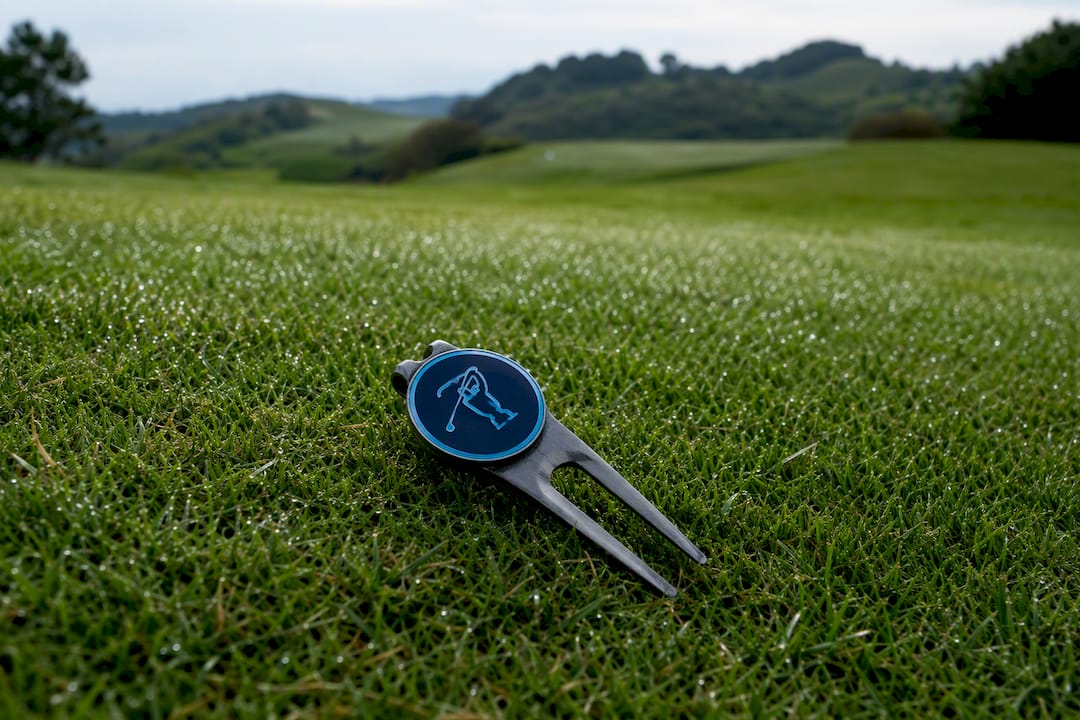
When you’re shopping for one, look for something small, unobtrusive, and easy to pick up cleanly with two fingers. Novelty markers are fun, but function comes first.
Etiquette and the mistakes that actually cost strokes
You don’t have to mark your ball every single time, but you should mark it whenever it’s anywhere near another player’s line, or whenever asked. That second part isn’t optional. If a fellow golfer asks you to mark, you mark, no debate.
A few habits separate considerate golfers from the ones playing partners quietly grumble about:
- Skip the oversized, flashy, or reflective markers that catch light and distract putters
- Mark proactively on the green rather than waiting to be asked
- Build marker removal into your pre-putt routine, right after you set the ball down
That last one matters more than people think. Even experienced players forget to remove their marker before putting, and it’s an easy penalty to avoid with one small habit change.
Pro Tip: Touch your marker as you stand up from placing your ball. That physical cue makes forgetting to remove it before your stroke almost impossible.
Ball marker vs. ball mark: don’t mix these up
A ball marker and a ball mark are two completely different things, and the overlapping name confuses a lot of newer players. Your marker is the object you place on the green. A ball mark, also called a pitch mark, is the small crater your ball leaves in the turf when it lands.
Repairing a pitch mark takes ten seconds and matters for the health of the green. Here’s the quick version:
- Insert your divot tool at the edge of the mark, not the center
- Gently push the surrounding turf toward the middle
- Tap it flat with your putter once it’s level
Plenty of divot tools now come with a magnetic marker built right in, one accessory covering both jobs, which is part of why they’ve become a pocket staple for regular players.
Publisher perspective: small gear, big culture

Golf runs on small rituals, and a ball marker is one of the smallest. Broken Tee Vodka includes a branded marker with every bottle, not as a gimmick, but because these little objects are woven into how the game gets played and remembered. Rules and etiquette come first, always, no accessory changes that.
Once the round’s over and the scorecards are signed, that’s when a golf-inspired cocktail or a 19th hole pour fits naturally into the day. If you’re shopping for the golfer in your life, Broken Tee Vodka makes a fitting gift, and every bottle already comes with its own marker tucked inside.
— Chip Mulligan


