

Four Step Online Alcohol Age Verification U.S. Retailers Must Use
If you sell alcohol online in the U.S., the minimum defensible approach is a documented, multi-step verification flow: checkout identity verification, delivery-level ID or signature check, plus audit-ready records. Skip any one of those pieces and you’re leaning on a DOB checkbox, which regulators increasingly treat as negligent rather than compliant. State rules vary, so your flow needs to flex by destination, not run on a single national setting.
TL;DR:
- A documented, multi-step verification process is essential for legal compliance and includes checkout identity checks, delivery ID matching, signature collection, and audit records.
- States like Texas and Utah will intensify their requirements in 2026, making flexible, destination-specific verification flows critical to stay compliant.
- Combining less intrusive methods like age-estimation or data match for most orders and escalating to full ID capture only for risky cases maintains balance between speed and security.
- Delivery staff must verify the recipient’s ID, obtain a signature, and record all verification data to ensure enforceable proof of age and delivery.
- Building a flexible, rules-based system that adapts to state-specific regulations and maintains comprehensive records is key to avoiding license loss and legal penalties.
Table of Contents
- What Is Alcohol Age Verification Online, and Why Does the Law Require It?
- The Defensible 4-Step Age-Verification Workflow Direct Shippers Use
- Common Verification Methods: How They Work and Where They Fall Short
- Delivery and Carrier Obligations: Adult Signature and ID Checks
- State-by-State Variation and Building a Dynamic Verification Flow
- Implementation Checklist: What to Do Now
- How We Think About Verification at Broken Tee Vodka
- Editorial Take: What the Compliance Conversation Gets Wrong
- See a Compliance-Minded Checkout in Action
- Sources
- FAQ
What Is Alcohol Age Verification Online, and Why Does the Law Require It?
Alcohol age verification online is the process of confirming a buyer meets the legal purchase age before a sale ships. In the United States, that age is 21 everywhere, thanks to the federal minimum drinking age framework established in 23 USC 158, which ties highway funding to states that hold the line. Enforcement, though, happens at the state level. Liquor control boards, not federal agencies, hand out fines, suspend licenses, and shut down shipping privileges when a retailer’s verification looks careless.
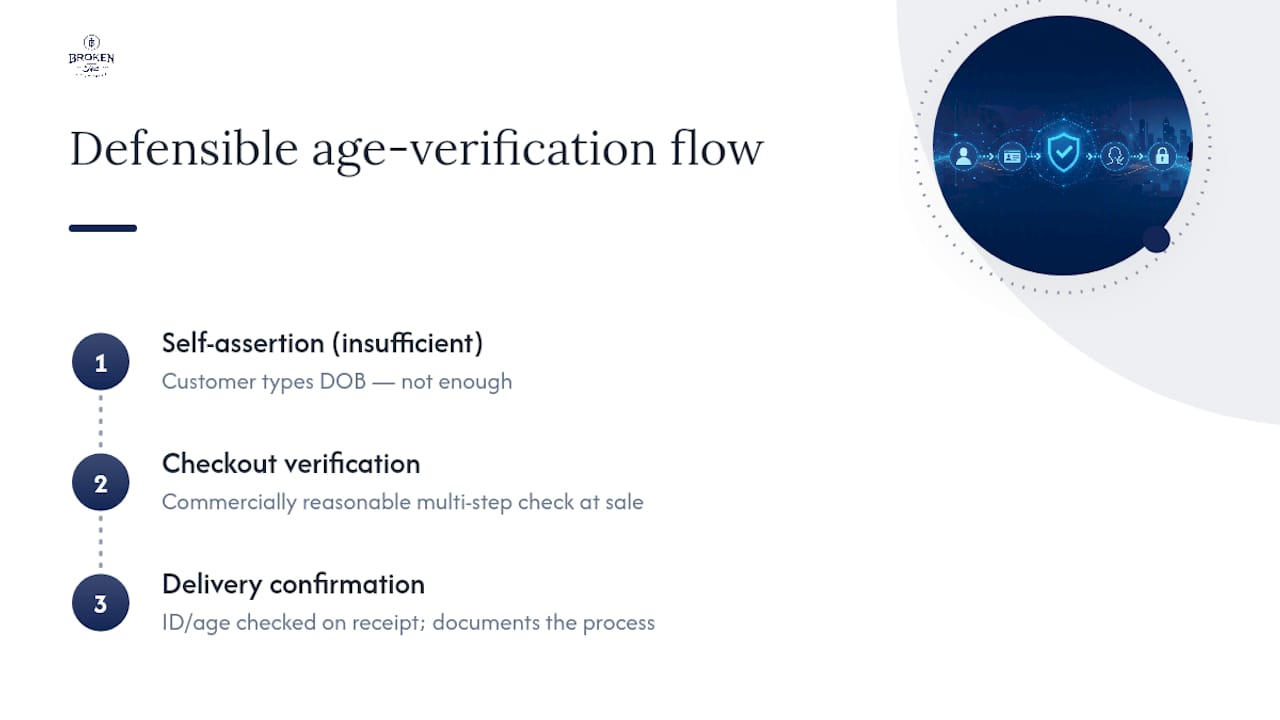
That’s why “self-assertion” (a customer typing in their own birthday) doesn’t hold up anymore. Regulators and courts increasingly ask a simpler question: did the seller use a commercially reasonable, multi-step system? A single checkbox says no. A documented process combining checkout verification with delivery confirmation says yes, even if an occasional edge case slips through. Defensibility, not perfection, is what keeps your license intact and your carrier relationships healthy.
The Defensible 4-Step Age-Verification Workflow Direct Shippers Use
Every credible direct-to-consumer alcohol business builds its checkout and fulfillment around the same backbone. States like Texas, Utah, and Louisiana tightened their verification mandates in 2026, and the four-step model Avalara outlines has become the practical standard for staying ahead of that trend.
- Entry-gate age affirmation. A pop-up or landing screen asking visitors to confirm they’re 21 or older before browsing. Store the date of birth if your state requires it, but treat this step as a filter, not proof.
- Checkout identity verification. Run the order through a data-match provider or a secure ID-capture step before payment clears. This is where you actually confirm identity, not just collect a claim.
- Delivery-level verification. The carrier or driver checks a government ID against the name on the package and collects an adult signature at the door. No ID, no signature, no delivery.
- Secure, auditable recordkeeping. Every verification event, from the data-match result to the delivery signature, gets logged and retained under a written policy you can produce on request.
Miss step 2 and you’re gambling on checkout fraud. Miss step 3 and a minor can simply have a package left on the porch. Miss step 4 and you have no way to prove any of it happened when a regulator eventually asks.
Common Verification Methods: How They Work and Where They Fall Short
No single method covers every order type well, so most compliant retailers blend a few.
- DOB input at the entry gate is fast and frictionless but proves nothing. Treat it as a soft filter, never as your verification of record.
- Data-match providers cross-reference the name, address, and birth date a shopper enters against public and credit-header records. Strong accuracy for adults with a stable address history; weaker for younger shoppers who move often or share a household address.
- ID image capture asks the buyer to photograph a driver’s license or passport. High accuracy and a solid audit trail, but it adds friction and creates sensitive image data you now have to store securely.
- Age-estimation tools analyze a selfie or behavioral signals to flag whether someone looks clearly over 21. Fast and privacy-friendlier since no document ID is needed, but best used as triage rather than a final answer.
- Persistence tokens remember a shopper who already passed verification, so repeat customers skip re-entering data on every order.
A pragmatic combo looks like this: let age-estimation or data-match handle the obvious cases, then escalate anyone borderline, high-value, or flagged for risk into full ID capture. That keeps checkout fast for most buyers while reserving your strongest checks for the orders that actually need them.
Pro Tip: Set your data-match confidence threshold conservatively at first. It’s far cheaper to manually review a handful of false flags than to explain a missed one to a state regulator.
Delivery and Carrier Obligations: Adult Signature and ID Checks
Checkout verification means nothing if the package ends up on a porch with no one checking who picked it up. Major carriers and most state statutes converge on the same delivery-side requirements:
- The recipient must be present and physically at the address at the time of delivery.
- A government-issued photo ID has to be shown and checked against the name on the shipping label.
- The driver collects a signature confirming the adult who received the package.
- The shipment must be manifested as containing alcohol, which triggers the carrier’s own age-restricted handling protocols under your shipping agreement.
This is the same standard the major delivery platforms already operate on: ID inspection paired with a captured signature at the door, with verified identities sometimes retained to speed up future orders. Capture and store three data points for every delivery: which ID type the driver checked, the signature itself, and a timestamp. That trio is what turns a delivery into evidence rather than a guess.
State-by-State Variation and Building a Dynamic Verification Flow
A single national checkout setting will eventually fail somewhere, because state rules diverge in ways that matter. Michigan, for instance, publishes an approved list of verification providers that direct shippers must use to stay compliant, while other states demand extra data fields at checkout or restrict direct-to-consumer shipping entirely for certain product categories.
Build your checkout around a simple rules engine instead of a fixed flow:
- Tag every order with its destination state before verification runs.
- Route stricter states to enhanced ID-capture or an approved third-party provider automatically.
- Geo-block or refuse shipment to states where your license or the product category doesn’t qualify for DTC sales.
- Flag any destination requiring licensed local fulfillment instead of direct shipment, and reroute the order accordingly.
Getting this wrong isn’t a paperwork issue. It’s the fastest way to lose your shipping privileges in a state that decides to make an example of a retailer.
Implementation Checklist: What to Do Now
- Audit every SKU and shipping destination, then map the legal constraints tied to each state you sell into. Cross-check ABV and labeling details while you’re at it, since product classification affects which rules apply.
- Select a checkout verification approach, data-match, ID capture, or a blend, that generates audit logs automatically rather than relying on manual notes.
- Integrate carrier adult-signature workflows into fulfillment, and train warehouse and delivery staff on what “verified” actually means at the door.
- Write a retention and deletion policy for verification data, and keep a dedicated audit folder for every state that might ask to see it.
How We Think About Verification at Broken Tee Vodka
A checkout and shipping flow can be built around the same four-step logic laid out here: gate, verify, confirm at delivery, and keep the paperwork. It’s not glamorous work, but it’s the difference between a retailer regulators trust and one they investigate. You can see the outline of that approach on our process page.
Editorial Take: What the Compliance Conversation Gets Wrong
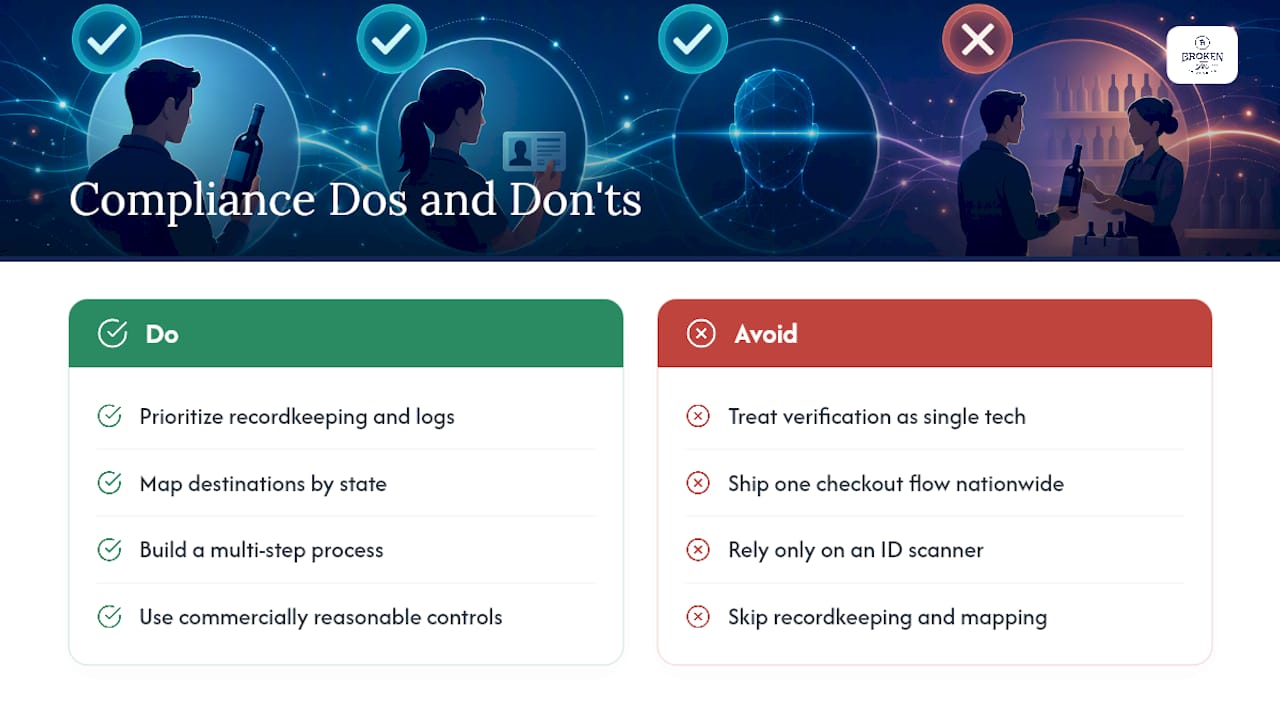
Most advice on this topic treats age verification like a single technology decision, pick the “best” ID-scanning vendor and move on. That’s backwards. The research is clear that regulators care about the system, not the tool: a commercially reasonable, multi-step process beats a single expensive point solution every time. A $2 DOB field paired with a solid delivery-signature policy and clean audit logs will outperform a fancy ID scanner bolted onto a checkout with no recordkeeping behind it.
The bigger blind spot is state variation. Retailers build one checkout flow, ship it nationally, and assume compliance is a solved problem. It isn’t. A flow that satisfies Michigan’s approved-provider list might fall short of Utah’s 2026 tightening. If you take one thing from this playbook, prioritize the recordkeeping and destination-mapping pieces first. They’re less exciting than picking a verification vendor, but they’re what actually holds up when a regulator asks you to prove your process worked.
— Chip Mulligan
See a Compliance-Minded Checkout in Action
Everything in this playbook, the entry gate, the checkout verification, the delivery signature capture, the audit trail, is baked into how we ship Broken Tee Vodka to golfers and golf clubs around the country. We’re not a compliance vendor selling you software. We’re a retailer that had to solve this problem for our own bottles, and we built our process around the same defensible workflow this article describes.

If you want to see what a compliance-first checkout actually looks like end to end, our store walks through age gating, identity verification, and delivery confirmation on every order. Golf clubs and retailers evaluating a wholesale partner can also check out our full spirits lineup to see how product classification and shipping rules play out on a real product catalog. Pick a bottle, run it through checkout, and see the verification steps for yourself.
Sources
- Getting it right: The 4 steps to age verification for direct shippers
- How is my age verified for alcohol orders?
- Age verification eCommerce retailers guide
- 23 USC 158: National minimum drinking age
This article is general information, not a substitute for advice from a qualified lawyer. Consult a qualified legal professional about your own circumstances before acting on anything here.
FAQ
Which States Have Online Age Verification Requirements?
Every state requires some form of age verification for online alcohol sales, but the strictness varies widely. Michigan, for example, maintains a list of approved third-party verification providers that direct shippers must use, while other states rely on general “commercially reasonable” standards without naming specific vendors.
Is Stricter Age Verification Coming to the USA?
Yes. States including Texas, Utah, and Louisiana tightened their online age-verification mandates in 2026, pushing retailers away from simple self-declaration and toward verified, multi-step identity checks. Expect more states to follow that pattern rather than reverse it.
How Do Alcohol Delivery Apps Verify Age?
Major delivery platforms verify age at purchase through ID capture or data matching, then require an in-person ID check and signature at the door. Many retain the verified ID on file so repeat customers face less friction on future orders.
Is There a Way to Verify Age Without an ID?
Data-match providers can confirm age using name, address, and birth date without scanning a physical document, and age-estimation tools can flag clearly over-21 shoppers using a photo or behavioral signals. Neither replaces ID checks for borderline cases or at delivery, where an adult signature and ID inspection remain standard.


