

Six Essentials for Country Club Bars: Craft Tools, High Volume Par Levels
Six categories make or break a country club bar: handheld tools, glassware, ice and refrigeration, speed and workflow gear, consumables, and a par-level system that ties it all together. Get those six right and your bar runs like the 19th hole should, fast, polished, and never out of anything mid-rush. Use the checklists and par examples below to size your first order or your next restock, and lean on the vendor and product links throughout for the specifics.
TL;DR:
- The bar should stock enough jiggers, shakers, and strainers based on volume, with back-up tools kept nearby to handle mid-service emergencies.
- Glassware par levels vary widely, with high-volume clubs requiring over 200 glasses in rotation to prevent breakage and meet demand during busy events.
- An ice maker capable of producing at least 350 pounds daily is essential to accommodate weekend and event spikes, with strict hygiene practices for handling ice.
- The bar’s workflow must be optimized with calibrated pour spouts, staged garnishes, and clearly labeled bottles to speed service and reduce errors during peak times.
- Consistent staff training, recipe standardization, and rigorous safety practices are critical to maintaining quality, safety, and smooth operation during busy tournaments and quieter days.
Table of Contents
- What Are the Country Club Bar Essentials for Core Cocktail Tools?
- Glassware Types and Par Levels for a Club Bar
- Speed, Workflow, and Front-of-House Tooling
- Ice, Refrigeration, and Large Equipment: Sizing It Right
- Consumables, Mixers, and Restock Cadence
- What Should a Country Club Bar Always Be Ready to Pour?
- A Club-Focused Note on Spirit Selection
- How Should a Club Bar Track Inventory?
- How Do You Train Staff to Pour Consistently?
- What Health and Safety Rules Apply to a Club Bar?
- Staging for Tournament Weekends vs. a Quiet Weekday Lounge
- Broken Tee Vodka: A 19th-Hole Spirit Worth Stocking
- Sources
- FAQ
What Are the Country Club Bar Essentials for Core Cocktail Tools?
Every great pour starts with the right hardware in the right hand. Before you think about garnish wells or glass polish, get the handheld tools locked down. These are the pieces your bartenders touch a thousand times a night, so quality and consistency matter more here than almost anywhere else in the bar.
Professional setups lean on weighted Boston tins in 28-ounce and 18-ounce sizes, paired with a double-sided jigger, Hawthorne and fine-mesh strainers, a 30-centimeter twisted bar spoon, a mixing glass, a flat-head muddler, and a citrus juicer.
Your core shopping list should include:
- Boston shaker tins (28oz and 18oz) for tin-on-tin shaking, plus a cobbler shaker for guest-facing service
- Double-sided jiggers with calibrated measurements (0.5oz/0.75oz and 1oz/1.5oz are the most useful combo)
- Hawthorne strainer and fine-mesh strainer for double-straining citrus cocktails
- Julep strainer for stirred drinks served over ice
- 30cm twisted bar spoon for layering and stirring
- Mixing glass dedicated to stirred cocktails like the Manhattan and Old Fashioned
- Flat-head muddler for herbs and fruit
- Y-peeler or channel knife for citrus twists and garnish work
- Citrus press or juicer, plus a paring knife for prep
Industry commentary consistently points to the jigger as the single most indispensable tool on the bar top, since accurate measuring is what separates amateur pours from professional service. A club bar pouring inconsistent Old Fashioneds on a Saturday tournament night is a bar that generates complaints, not repeat business.
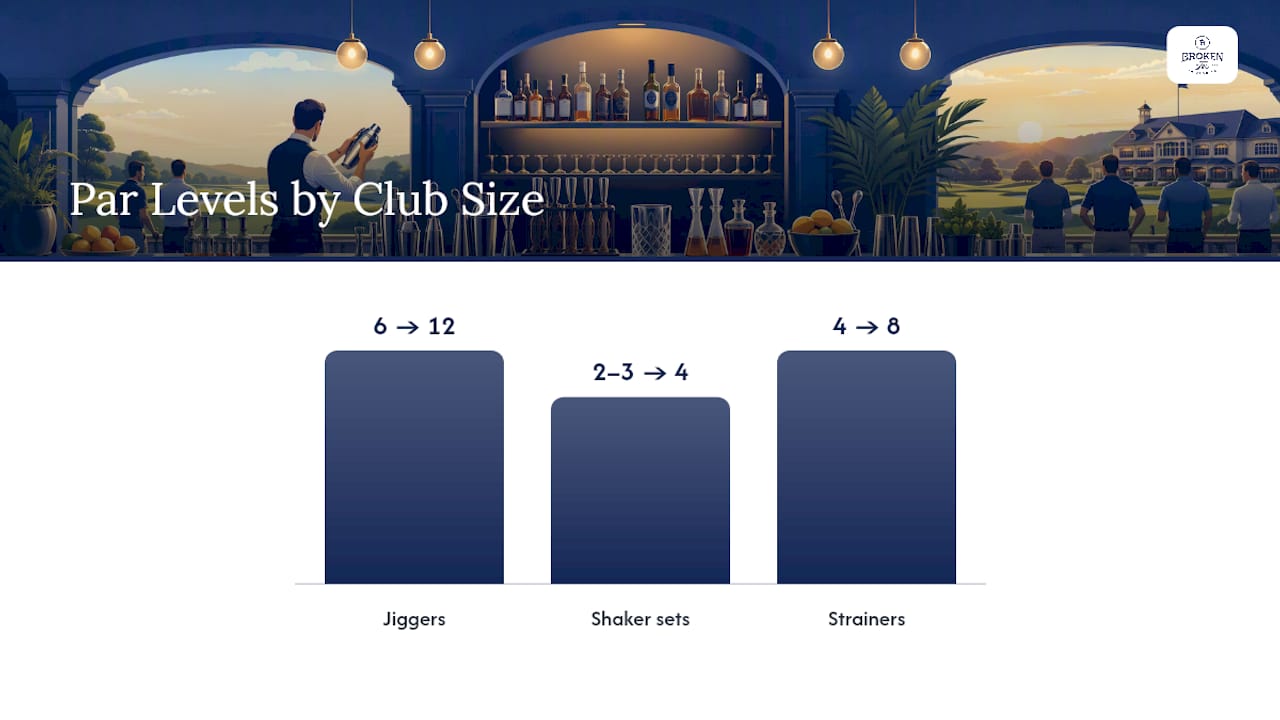
Par levels depend on your volume. A small clubhouse lounge can run comfortably with 6 jiggers, 2 to 3 shaker sets, and 4 strainers. A mid-size club hosting weekend events should stock closer to 12 jiggers, 4 shaker sets, and 8 strainers, with backups for anything that gets dropped, bent, or borrowed by the kitchen. Standardizing on one weighted tin size and one calibrated pour spout across every station reduces substitution errors and speeds up service when three bartenders are working the same well during a shotgun-start breakfast rush.
Pro Tip: Keep a small “emergency kit” behind the bar with one spare of every high-touch tool: a jigger, a spoon, a peeler. It costs almost nothing and saves you from a mid-service scramble when something goes missing during a member-guest tournament.
Glassware Types and Par Levels for a Club Bar
Six glass shapes cover the vast majority of club orders: rocks, highball or Collins, coupe or Nick & Nora (for up-market martini service), red and white wine glasses, pint glasses, and shot glasses. Specialty shapes like a snifter for brandy service, a copper mug for a vodka mule, or champagne flutes for banquet toasts round out a menu built for both weekday golfers and formal club events.
Par levels scale with your service calendar, not just your seat count. A quiet weekday lounge might need 48 rocks glasses in rotation. A mid-volume clubhouse running lunch and dinner service comfortably needs closer to 96. A high-volume club with banquet halls, tournament weekends, and wedding bookings should plan for 200 or more, accounting for breakage, the dish pit backlog during peak events, and the reality that glassware disappears onto patios and golf carts.
A practical starting breakdown for a mid-size club:
- Rocks glasses: 96 to 120 for spirit-forward drinks and neat pours
- Highball/Collins glasses: 72 to 96 for mules, G&Ts, and long drinks
- Coupe or Nick & Nora glasses: 48 to 72 for martinis and up cocktails
- Wine glasses (red and white): 96 each minimum, more if you run a banquet program
- Pint glasses: 48 to 72 depending on beer program size
- Shot glasses: 48, since these see heavy rotation during celebratory rounds
Durability should drive your buying decision more than looks. Tempered rim glassware costs more upfront but survives commercial dish machines and careless bussing far better than delicate stemware. Reserve your prettiest coupes and Nick & Nora glasses for member events and formal dining, and stock a sturdier everyday set for the halfway house and outdoor patio bar where breakage runs highest. Budgeting matters here too: outfitting a full bar program’s glassware and small-wares can run $12,000 to $25,000 for a 30-seat operation, so plan replacements in phases rather than trying to stock every shape at premium quality on day one.
Speed, Workflow, and Front-of-House Tooling
A bar can have every tool and glass imaginable and still crawl through service if the layout fights the bartender. Speed rail placement, pour spout calibration, and garnish accessibility are what turn a well-stocked bar into a fast one.
Set your bar up with this workflow in mind:
- Calibrate your speed rail with your highest-volume spirits front and center, positioned in the order your recipes call for them, and choose one standard pour spout size across every well bottle so no bartender is guessing at flow rate mid-rush.
- Stock spare pour spouts at a ratio of at least two backups per well bottle. Spouts clog and crack more often than most managers expect, and standardized pours cut down on both wasted product and service errors.
- Build a six-pan cold garnish well with tight-fitting lids to keep citrus, olives, and cherries fresh through a full shift without drying out.
- Label your dasher and dropper bottles clearly for bitters, saline solution, and syrups so nobody reaches for the wrong bottle during a rush.
- Stage bar mats, non-skid service trays, glass towels, and check presenters within arm’s reach of the well, along with a reliable bottle opener and waiter’s corkscrew at every station.
- Set par counts for consumables at the station level, not just in the back stock room, so a bartender never has to leave the well to hunt for napkins during a tee-time rush.
That last point matters more than it sounds. A club bar during a member-guest tournament can see 40 drink tickets in 15 minutes. If garnish, spouts, and glassware aren’t staged for that exact moment, the line backs up no matter how skilled your staff is.
Ice, Refrigeration, and Large Equipment: Sizing It Right
Ice is the most underestimated piece of country club bar equipment, and it’s also the one most likely to shut down service if you get the sizing wrong. A busy bar can burn through up to 300 pounds of ice on a single Saturday night, which means an undersized machine leaves you scrambling to buy bagged ice from a grocery store mid-shift. That’s a real scenario, and it happens more often than club managers admit.
::: An ice maker capable of producing at least 350 pounds per 24 hours is the practical minimum for any club bar that runs a full weekend schedule. Anything smaller leaves no cushion for tournament weekends or banquet double-bookings. :::
Match your ice type to your drink program. Clear, large-format cubes or spheres suit spirit-forward classics like an Old Fashioned or a neat pour, since they melt slowly and look sharp in a rocks glass. Crushed ice belongs in juleps and tiki-style drinks. Specialty molds and sphere presses work well as a small up-sell on premium cocktails during member events.
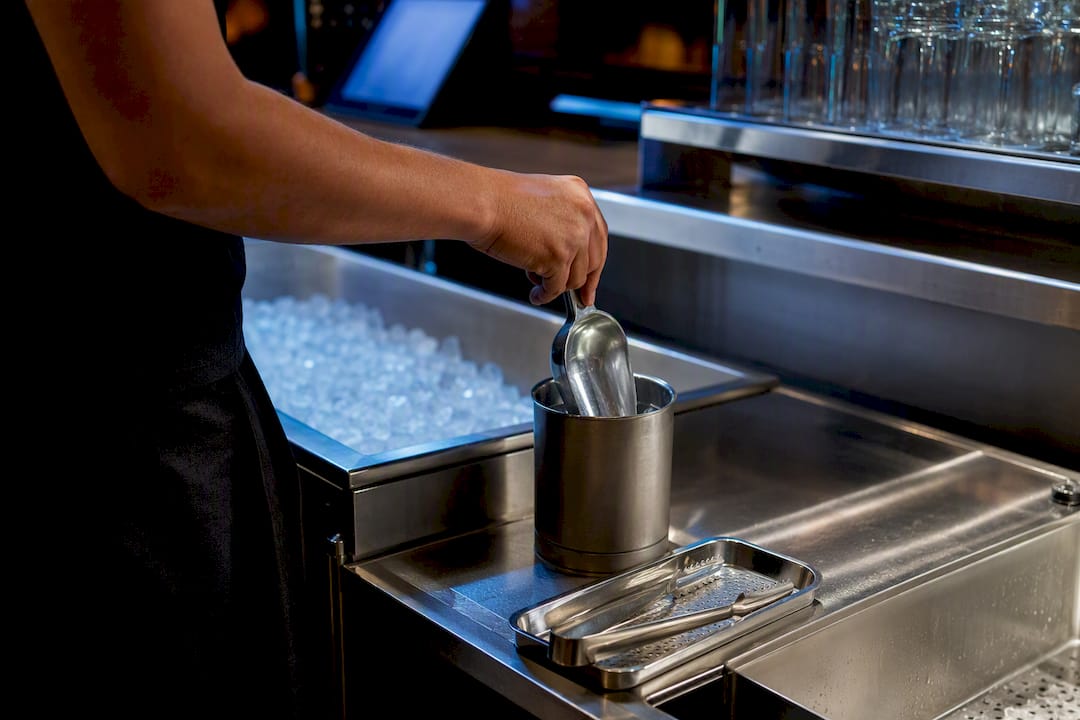
Hygiene discipline around ice deserves real attention. Scoops should never be stored inside the ice bin, since hands and countertops introduce bacteria every time the scoop goes back in. Keep a dedicated scoop for the bin, a separate pair of tongs for garnish, and put a cleaning and rotation schedule on the wall so nobody has to guess when the bin was last sanitized.
Round out your cold-storage plan with an underbar fridge for daily-use mixers, a bottle chiller for white wine and sparkling service, and a kegerator if your beer program justifies the investment. Schedule quarterly maintenance on all of it. A compressor failure during a tournament weekend is the kind of problem you want to prevent, not troubleshoot.
Consumables, Mixers, and Restock Cadence
Your durable equipment can be flawless and the bar still fails a member if you run out of tonic on a Friday night. Consumables need their own par system, separate from tools and glassware, because they move fast and expire.
Baseline stock for any club bar should include:
- Carbonated mixers: tonic, club soda, ginger beer, and cola in enough volume to survive a full weekend without a mid-shift run
- Bottled mixers and juices: cranberry, orange, pineapple, and a quality sour mix or fresh-squeezed citrus program
- Syrups and bitters: simple syrup, a flavored syrup or two for signature cocktails, and at least Angostura and orange bitters
- Backup spirits: a second bottle of every well spirit behind the bar, plus a rotating vermouth stock since it oxidizes faster than most staff expect
- Fresh garnish: citrus arriving on a schedule tight enough that nothing sits more than a few days, stored in labeled, covered containers, with herbs kept hydrated in water rather than dry in a cooler
Order cadence should run on two tracks. A weekly baseline order covers steady, predictable usage. Event-driven top-up orders cover anything on the calendar, tournaments, weddings, member-guest weekends, sized against expected covers rather than a flat weekly number. If you’re planning a batched program for a big event, working out batched vodka cocktails ahead of time lets you calculate exact mixer and syrup quantities instead of guessing on the fly. Syrup sourcing and recipe ideas from a dedicated craft syrup guide can also help you build a signature syrup program without reinventing the wheel.
What Should a Country Club Bar Always Be Ready to Pour?
Members expect certain drinks to be right every single time, no exceptions and no substitutions. Build your program around these staples, and map the tool and glass each one needs so nobody scrambles mid-order.
- Martini: mixing glass, bar spoon, strainer, coupe or Nick & Nora glass
- Manhattan: mixing glass, bar spoon, strainer, rocks or coupe glass
- Old Fashioned: rocks glass, bar spoon, muddler for the sugar cube version
- Whiskey sour: shaker tins, fine strainer, rocks or coupe glass
- Gin and tonic: highball glass, jigger, no shaker needed
- Vodka mule: copper mug or highball, jigger, bar spoon
- Bloody Mary: pint or highball glass, jigger, bar spoon, garnish skewer
- Wine and beer service: appropriate stemware and pint glasses on standby at all times
For golf clubhouse drink orders specifically, keep your after-round staples front and center in the well, since the fourth hole rush and the post-round rush hit differently and both need speed. For banquet and event batching, planning dilution and labeling ahead of time, the way you would for golf wedding cocktail service, keeps large-format pours consistent from the first guest to the last.
A Club-Focused Note on Spirit Selection
Chip Mulligan has spent years covering how golf culture and bar service intersect at the country club level, and one pattern holds up: the spirits that earn a permanent spot behind the bar are the ones built for the audience actually standing at it.
This vodka runs through a sevenfold distillation and carbon filtration process built for smoothness, and every bottle ships with a branded ball marker. That combination of quality and golf-specific identity is exactly what a 19th-hole bar program is looking for.
A club bar doesn’t need dozens of vodka options. It needs one that fits the room, and one built specifically around the golf experience earns its shelf space differently than a generic top-shelf bottle. You can see the distillation process behind it directly on the brand’s site.
How Should a Club Bar Track Inventory?
Spreadsheets work for a small lounge. Once you’re running multiple bars, a banquet hall, and an outdoor halfway house, you need a system that counts pours, not just bottles.
Most country club operations land on one of three approaches: manual par sheets counted at close, barcode-based POS inventory modules tied to your point-of-sale system, or smart pour-spout systems that track ounces dispensed in real time. The right choice depends on how many bars you’re running and how tightly your board wants cost-of-goods tracked.
Whatever system you choose, build it around three numbers: opening count, closing count, and expected usage based on tickets rung. A gap between expected usage and actual depletion is your first sign of over-pouring, breakage, or shrinkage, and catching it weekly is far cheaper than catching it at year-end audit. Tie your par sheets directly to the same categories you’re stocking, tools, glassware, ice, and consumables, so a steward doing a Monday morning count isn’t reinventing the checklist from scratch. Clubs running multiple outlets (main bar, halfway house, banquet room) benefit from a single master par sheet with outlet-specific rows, since it catches the classic problem of one location over-ordering while another quietly runs dry.
How Do You Train Staff to Pour Consistently?
Consistency comes from repetition against a fixed standard, not from talent alone. New bartenders should shadow a senior staffer through at least one full weekend shift before working a station solo, watching exact jigger measurements, garnish placement, and glass selection for every core cocktail on the menu.
Build a laminated recipe card for every signature drink, listing exact pour amounts, garnish, and glassware, and keep it at the well rather than in a binder in the office. Run a monthly calibration check where every bartender free-pours a measured amount into a jigger to catch pour creep before it becomes a habit. Cross-train staff across every outlet, main bar, halfway house, banquet room, so a Saturday tournament doesn’t fall apart because your best bartender is stuck at the wrong station. Document substitutions and shortages in a shared log so the next shift isn’t caught off guard by a missing ingredient nobody flagged.
The clubs with the most consistent cocktail programs treat the recipe card as non-negotiable, the same way a kitchen treats a plating guide. A Manhattan should taste identical whether it’s poured on a quiet Tuesday or during the chaos of member-guest weekend.
What Health and Safety Rules Apply to a Club Bar?
Ice handling sits at the top of the list. Scoops never belong inside the bin, and every ice safety guideline for food service treats ice as a food product requiring the same contamination controls as anything coming out of the kitchen. That means dedicated scoops, covered storage, and a documented cleaning schedule for every ice bin on property.
Beyond ice, a club bar needs a clear glass-cleaning and sanitizing rotation, typically a three-compartment sink system of wash, rinse, and sanitize, plus scheduled deep cleaning of speed rails, mats, and drains where bacteria and mold build up fastest. Responsible alcohol service training for every bartender isn’t optional in most states and should be renewed on whatever cycle your local licensing authority requires. Keep a visible, current liquor license and a posted cutoff policy for over-service, since a country club’s liability exposure on a member-guest weekend with open bar service is real and worth taking seriously.
Temperature logs for refrigeration units, a fire suppression check on any equipment near open flame (think flambé garnishes at member events), and a documented incident log for any service refusal round out the basics. None of this is glamorous, but it’s the difference between a club bar that runs smoothly for years and one that ends up in a liability conversation with the board.
Staging for Tournament Weekends vs. a Quiet Weekday Lounge
Tournament weekends call for doubled par levels across ice, glassware, and consumables, plus refrigeration capacity that can absorb a banquet-sized rush without running dry by the back nine. A weekday lounge runs lean by comparison, with a single bartender covering a fraction of the volume. Staffing ratios shift accordingly, and a useful benchmark is one bartender per 35 to 50 guests for anything resembling a formal event.
Pro Tip: Build your tournament-day par sheet the week before, not the morning of, so restocking during the event is a top-up, not a scramble. Sanitation discipline can’t slip just because the ticket count triples.
— Chip Mulligan
Broken Tee Vodka: A 19th-Hole Spirit Worth Stocking
If your club bar already has the tools, ice, and glassware dialed in, the next upgrade is what’s actually in the well. Broken Tee Vodka was built for exactly the crowd standing at your bar after a round, golfers who want a smooth, quality pour that fits the spirit of the game rather than a generic bottle pulled off a distributor’s standard list.
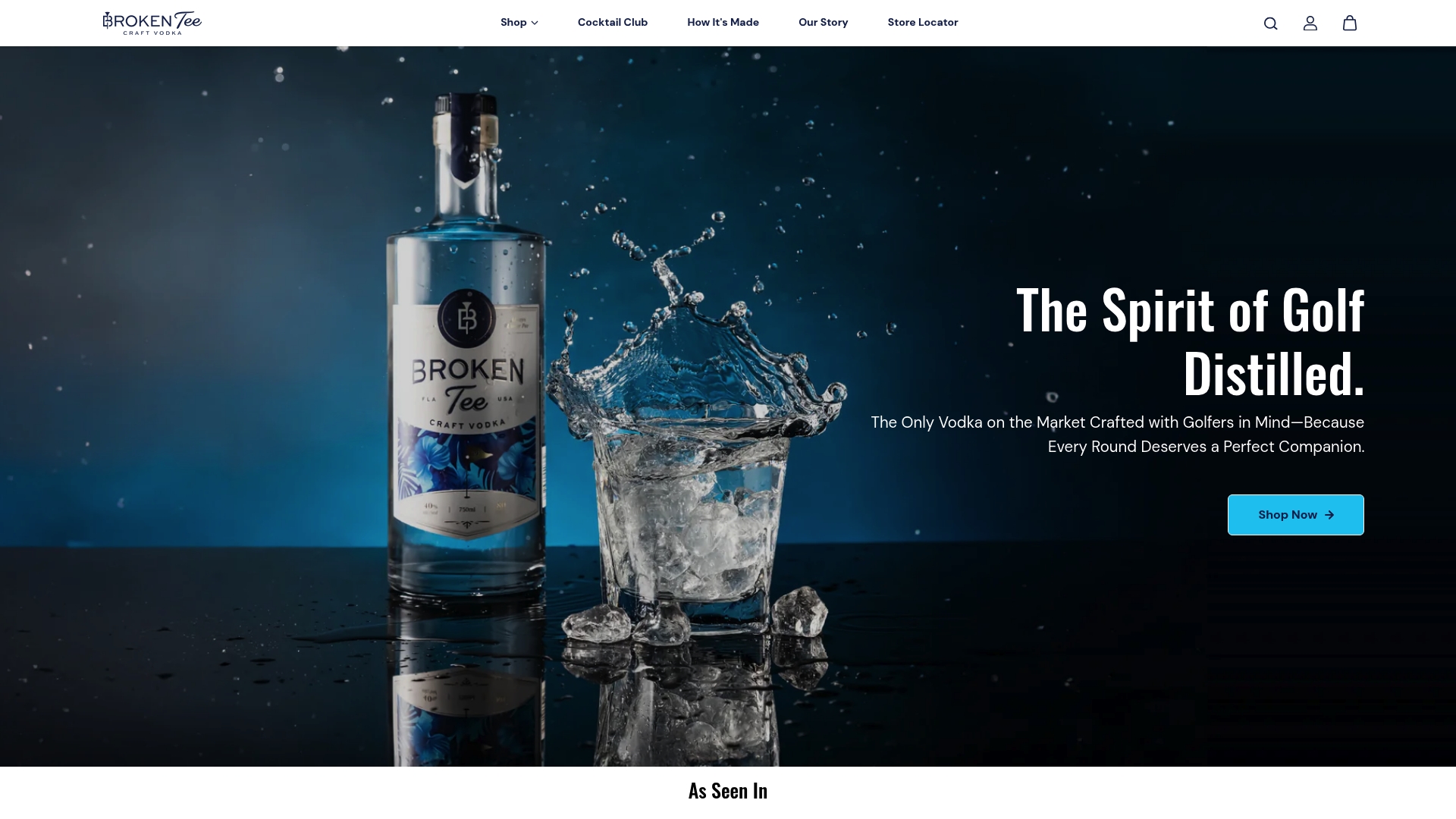
It batches beautifully for a Moscow Mule service at the halfway house, pours clean as a signature vodka soda at the 19th hole, and every bottle ships with a branded ball marker that members notice. It’s an easy addition to a wine or Bloody Mary program already built around fresh garnish and quality mixers. If you’re sourcing spirits for your club’s bar program or looking to add a golf-specific option to your merchandise shop, shop Broken Tee Vodka directly and see how it fits your next order.
Sources
- Bar essentials: The complete bar supplies checklist — Bar Products
- Coldline EIC350M-FA ice maker product page — Chef’s Deal
- Cocktail bar jiggers — 360training blog
FAQ
What are the essential items for a bar?
The core essentials are handheld tools (jiggers, shakers, strainers, bar spoons), workhorse glassware, a reliable ice supply, refrigeration, speed rail setup, and a stocked consumables inventory of mixers, garnishes, and backup spirits.
What are the essential supplies for a bar?
Beyond tools and glassware, essential supplies include pour spouts, bar mats, glass towels, garnish containers, cleaning and sanitizing solution, and enough backup stock of high-touch items like jiggers and strainers to survive a busy shift without improvising.
What are the essential items for a well-stocked bar?
A well-stocked country club bar keeps par levels for six categories: cocktail tools, glassware, ice and refrigeration equipment, workflow gear like speed rails and garnish stations, mixers and consumables, and backup spirits, including a golf-friendly option like Broken Tee Vodka for the 19th-hole crowd.
What are 20 common bar tools and equipment?
A typical list covers Boston shaker tins, a cobbler shaker, double-sided jiggers, Hawthorne and fine-mesh strainers, a julep strainer, a bar spoon, a mixing glass, a muddler, a Y-peeler, a channel knife, a citrus press, a paring knife, pour spouts, an ice scoop, tongs, a speed rail, bar mats, glass towels, a bottle opener, and a waiter’s corkscrew.
How much ice does a country club bar need on a busy night?
Busy bars can go through up to 300 pounds of ice in a single Saturday night, which is why most club bars size their ice maker to produce at least 350 pounds every 24 hours.


