

Golf Event Drink Quantities: How to Calculate What You Need
Plan for two drinks per guest in the first hour and one drink per guest for every hour after that. For a 4-hour golf event with guests, that formula lands you at around five drinks per guest in total. That number is your starting point for every bottle, keg, and case order you’ll place.
Here’s the quick math: 100 guests × 2 drinks (hour one) = 200 drinks, plus 100 guests × 1 drink × 3 remaining hours = 300 drinks. Total: 500 drinks. Split roughly 60/40 between beer/seltzer and everything else, and you’re looking at around 300 beers, 100 wine servings (about 17 bottles), and 100 mixed drinks or spirit pours (about 4 bottles of vodka).
Three conversions to keep handy while you shop:
- A standard 750 mL wine bottle pours 5 to 6 glasses, per event drink planning guidance.
- A 750 mL spirit bottle yields about 28 measures at a 25 mL pour, using the same source.
- A half keg (15.5 gallons) pours roughly 165 twelve-ounce servings; a quarter keg pours about 82.
Key Takeaways
Golf event drink quantities come down to one formula, applied consistently: 2 drinks per guest in the first hour, 1 per hour after, then converted into bottles, cans, and kegs using standard pour yields.
| Point | Details |
|---|---|
| Use the standard formula | Plan 2 drinks per guest for hour one, then 1 per hour after, and adjust 10% to 20% for heavy-drinking crowds. |
| Convert totals into units | A 750 mL wine bottle pours 5 to 6 glasses; a 750 mL spirit bottle pours about 28 measures. |
| Split by event type | Daytime and hot-weather rounds should lean 55% to 60% beer and seltzer, with wine and spirits filling the rest. |
| Place drinks on-course | Set coolers every 2 to 3 holes and add one keg hole or beverage cart for every 50 to 75 guests. |
| Verify venue rules early | Some courses charge a 20% outside-catering fee or require alcohol purchased through their concessionaire. |
| Order spirits by the case | Broken Tee Vodka’s case bundle covers enough spirits for a 200-guest tournament at a standard split. |
Table of Contents
- Golf Event Drink Quantities Formula: Step-by-Step
- How Should You Split Beer, Wine, Spirits, and Non-Alcoholic Drinks?
- How Do You Get Drinks to Golfers on the Course?
- Drink Templates for 9-Hole, 18-Hole, and Reception Events
- What Should Be on Your Beverage Shopping List?
- How Many Bartenders Do You Need for a Golf Event?
- What Do Experienced Golf Event Planners Get Wrong?
- Broken Tee Vodka Is Built for This Exact Event
- Frequently Asked Questions
- Sources
Golf Event Drink Quantities Formula: Step-by-Step
The baseline formula event caterers rely on is front-loaded: guests drink more in the first hour of any gathering, then settle into a slower pace. The most common version plans 2 drinks per guest for hour one, then 1 drink per guest for each additional hour, according to drink quantity benchmarks used across event planning. A second widely used variant, built into several online alcohol calculators, runs 1 drink per guest per hour for the first two hours, then 0.5 drinks per hour after that. Both variants land in a similar range for a standard 4-hour outing. Use the front-loaded version for tournaments with an active shotgun start and lots of early energy; use the tapering version for longer, more relaxed formats like member-guest weekends.
Here’s how to run the numbers yourself:
- Confirm your guest count and event duration in hours.
- Apply the formula (2 + 1/hour, or 1/hour for two hours then 0.5/hour) to get total drinks per guest.
- Multiply by total guest count for your event total.
- Apply a multiplier if your crowd skews toward heavier drinking: add 10% to 20% for a corporate outing with an open bar, or a golf buddy trip with an evening reception.
- Subtract 15% to 20% off the alcohol total for guests who’ll stick to non-alcoholic options, then add that volume back in as water, soda, or mocktails.
Once you have a total, converting it into purchase units is straightforward:
Worked example, 100 guests, 4 hours: 500 total drinks.
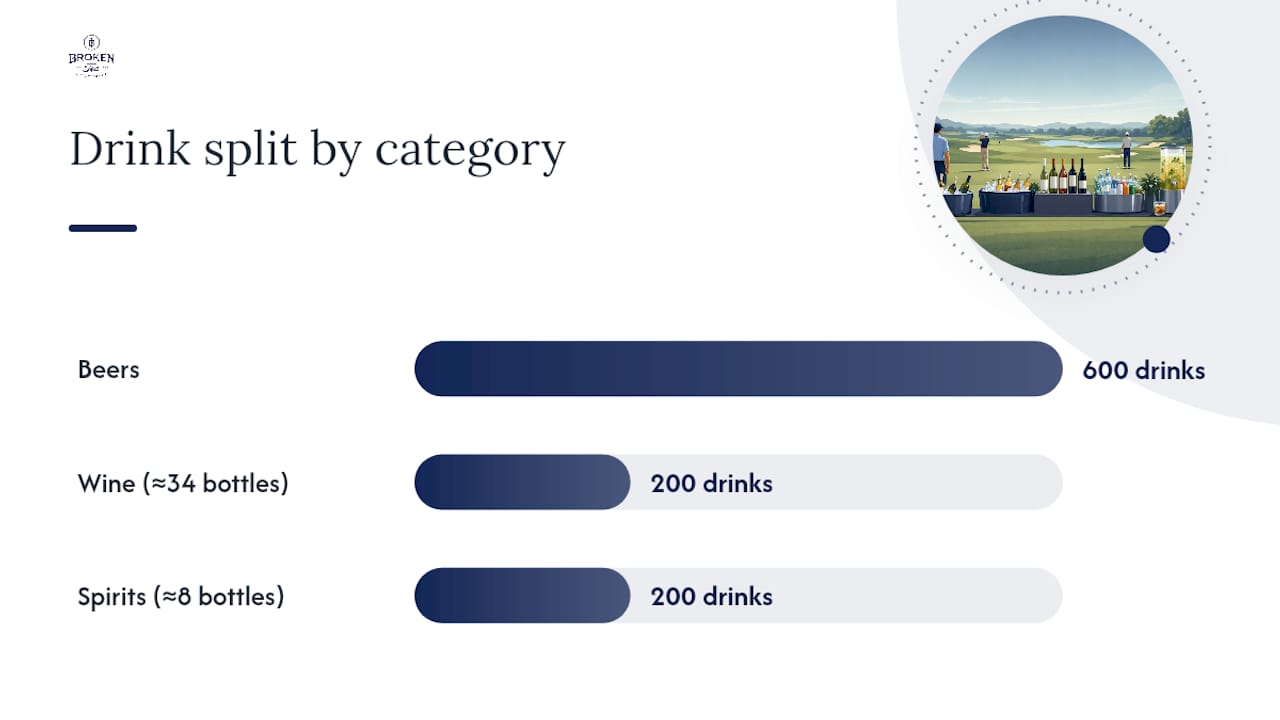
Worked example, 200 guests, 4 hours: 1,000 total drinks. Same split gives you 600 beers, 200 wine servings (about 34 bottles), and 200 spirit pours (about 8 bottles).
Scale down by a similar margin for a morning shotgun start with a lighter, brunch-style crowd.
How Should You Split Beer, Wine, Spirits, and Non-Alcoholic Drinks?
Hot-weather rounds change the math further. On-course consumption skews hard toward cold, easy-to-carry drinks, so push your beer and hard seltzer allocation up to 60% or higher during summer tournaments, and cut wine back to a token clubhouse pour reserved for the reception.
Once you’ve picked a split, apply the percentages to your total drink count from the formula section. A 500-drink, 4-hour event at a 55/15/10/20 split gives you 275 beers, 75 wine servings, 50 spirit pours, and 100 non-alcoholic drinks.
A few practical notes on format:
- Canned beer and seltzer travel better on carts than bottles. No glass to worry about near tee boxes, and cans chill faster in a cooler than bottles do.
- Sixteen-ounce cans reduce the number of cooler restocks compared to twelve-ounce cans, which matters when you’re covering 18 holes.
- Wine works best staged at the clubhouse or a single beverage cart rather than spread across every hole, since it needs glassware and a steadier pour.
Pro Tip: Freeze a layer of water bottles at the bottom of each cooler the night before. They act as reusable ice packs, keep cans colder longer in afternoon heat, and double as backup water once they thaw.
How Do You Get Drinks to Golfers on the Course?
Getting the math right doesn’t matter if guests can’t reach a drink between the 3rd hole and the 15th. Golf event refreshment planning is as much about placement as quantity.
On-course placement checklist:
- One mobile beverage cart per 50 to 75 guests for an 18-hole shotgun format.
- A stationary cooler at every second or third tee box, based on practitioner recommendations from golf outing beverage planning.
- For events over 150 guests, designate one or two “keg holes,” typically a par-3 with room for a table and quick pours, an approach PGA tournament staff use regularly.
- Plan on 1 to 3 ice-cold drinks per player per nine holes as your on-course target, per the same practitioner guidance.
Sponsorship and ticketing options to decide early:
- Drink tickets: caps consumption, controls cost, and gives sponsors clean branding on a physical item.
- Sponsored beverage cart: a company underwrites the cart in exchange for signage and cart-wrap branding, which reduces per-player purchasing costs for the organizer.
- Cash bar: shifts cost to guests directly but slows service and needs point-of-sale staffing at every station.
Course rules can override your plan entirely, so confirm outside-beverage policy before you finalize a shopping list. Some facilities require alcohol purchased through their own concessionaire and bar exclusivity clauses aren’t rare.
Pro Tip: Walk the actual course layout with your beverage plan in hand before finalizing cart routes. A map looks fine on paper, but a cart path that loops back on itself wastes a driver’s whole afternoon.
Drink Templates for 9-Hole, 18-Hole, and Reception Events
Different golf formats call for different assumptions. Here’s how three common event types break down for 50, 100, and 200 guests, using a per-guest baseline of 3 drinks for a 9-hole scramble (roughly 2 hours), 5 drinks for an 18-hole tournament (4 hours), and 3 drinks for a 2-hour post-round reception.
- 9-hole scramble (2 hours, 3 drinks/guest): 50 guests = 150 drinks; 100 guests = 300 drinks; 200 guests = 600 drinks.
- 18-hole tournament (4 hours, 5 drinks/guest): 50 guests = 250 drinks; 100 guests = 500 drinks; 200 guests = 1,000 drinks.
- Post-round clubhouse reception (2 hours, 3 drinks/guest): 50 guests = 150 drinks; 100 guests = 300 drinks; 200 guests = 600 drinks.
Round every case up, never down. Beer typically sells in cases of 24, so 180 cans rounds to eight cases. Wine at 10 bottles stays as-is, since most distributors sell by the bottle or by the case of 12. Round up rather than short yourself mid-event.
What Should Be on Your Beverage Shopping List?
Beyond bottles and cans, a few line items get overlooked until it’s too late to fix them on tournament morning.
- Ice: plan for 1 to 1.5 pounds per guest for a 4-hour outdoor event, more if temperatures run above 85 degrees.
- Mixers: tonic, soda water, cola, and a citrus juice cover most vodka and gin pours; buy in 2-liter bottles to reduce waste.
- Garnishes: limes, lemons, and olives, roughly one lime per 8 to 10 cocktails.
- Cups: plastic 12-ounce cups for beer and cocktails, plus a smaller 5-ounce cup if you’re pouring wine, at 1.2 cups per guest per hour to cover spills and refills.
- Glassware or branded cups: a nice touch for a clubhouse reception, less practical for on-course carts.
It’s far cheaper to return unopened cases than to run dry two hours into a tournament. If your case count comes out odd, round up to the next full case rather than leaving a gap on a hot afternoon. For smaller groups under 75 guests, cans and bottles usually beat a keg on cost and flexibility; a keg only pays off once you clear roughly 100 beer drinkers.
How Many Bartenders Do You Need for a Golf Event?
Staff one bartender per 50 to 75 guests at a stationary bar, and one server per beverage cart covering no more than 75 to 100 golfers across 18 holes. Add a float staffer for every 150 guests to restock coolers and cover breaks, a lesson large-scale operators like the Aramark team running PGA TOUR events apply even at massive scale.
Before you lock in your beverage plan, verify these venue items in writing:
- Does the facility permit outside alcohol, or does it require purchase through an in-house concessionaire?
- Is there an outside-catering fee? One public golf course contract lists a 20% surcharge for outside food and beverage brought in without written approval.
- What insurance certificates or liquor liability coverage does the venue require from you or your caterer?
For safety, pace service on-course the same way you would at a wedding bar: no more than one alcoholic pour per cart stop, and cut off high-ABV shots on holes where players are actively operating motorized carts.
What Do Experienced Golf Event Planners Get Wrong?
Underordering ice is the most common miss, and it’s the easiest to fix: double whatever number feels right, since coolers empty faster outdoors than anyone expects. Second is spacing coolers too far apart, leaving back-nine groups dry by hole 14. Third is assuming venue rules match last year’s, when contracts change and outside-beverage penalties get stricter every season.
Immediate actions with 48 to 72 hours to go: confirm final headcount, reconfirm venue alcohol policy in writing, recheck cooler and cart placement against the actual course map, and add one extra case of whatever sold out fastest last time.
Broken Tee Vodka Is Built for This Exact Event
Broken Tee Vodka gives tournament organizers a spirit that’s actually made for the course, not just poured on it. The 1 Case Bundle with free shipping makes that math simple to order in one shot instead of piecing together bottle counts at checkout.
For clubhouse service, a Broken Tee Vodka soda with fresh lime is the easiest crowd-pleasing pour on the list: two ounces of vodka, four ounces of soda water, a lime wedge, over ice. It scales cleanly for a 100-person reception with nothing more than a folding table and a cooler of limes. Browse more golf-friendly vodka drink ideas if you want a second option on the menu. Place your order at least a week out from tournament day to leave room for delivery and any last-minute headcount changes, and check current case pricing directly on the Broken Tee Vodka shop before you finalize your beverage order.
Frequently Asked Questions
How many drinks should I plan per guest for a 4-hour golf tournament? Plan on roughly 5 drinks per guest for a 4-hour event, using the 2-drinks-first-hour, 1-drink-per-hour-after formula from standard event drink guidance.
How much ice do I need for a golf tournament? Budget 1 to 1.5 pounds of ice per guest for a 4-hour outdoor event, and lean toward the higher end for afternoon rounds above 85 degrees.
Should I use kegs or cans for a golf event? Cans work better for groups under 100 beer drinkers because they’re easier to move by cart and chill faster; kegs become cost-effective once you clear roughly 100 beer servings and can be staged at a designated hole.
How do I handle non-alcoholic drinks for a golf outing?
Can I bring my own alcohol to a golf course event?
Sources
- Event Drinks Quantity Guide — How Much Per Guest
- Alcohol Per Guest Calculator 2026 | Hacé Cuentas
- A Q&A With PGA Professionals: Tournament Food & Beverage
- Winston-Lake Golf Course Tournament Contract (PDF)
Recommended
- Mini Liquor Bottles: A Golfer’s Guide to the Small Stuff – Broken Tee Vodka
- Big-Batch Party Vodka Drinks for Golf Crews – Broken Tee Vodka
- From Hole-In-One to Happy Hour: What to Drink When You’re Done Golfing – Broken Tee Vodka
- The Best Golf Course Drinks You Can’t Live Without (And the Shots You – Broken Tee Vodka


