

Simulator First: Keep Your Home Golf Bar 4–6 ft From the Swing
Put your bar to the side of the hitting area, not behind it, and keep at least 4 to 6 feet between the swing path and the nearest stool. Start with a 4 to 6 foot side-wall counter and a 3.2 to 4.5 cu ft mini-fridge. That single combo covers safety, function, and cost better than any bigger build you could rush into. Add a kegerator or full wet bar once you know how often you’ll actually host.
TL;DR:
- Keep at least 6 to 8 feet of clearance behind the hitting zone for safety, or 4 to 6 feet if the bar runs along a side wall.
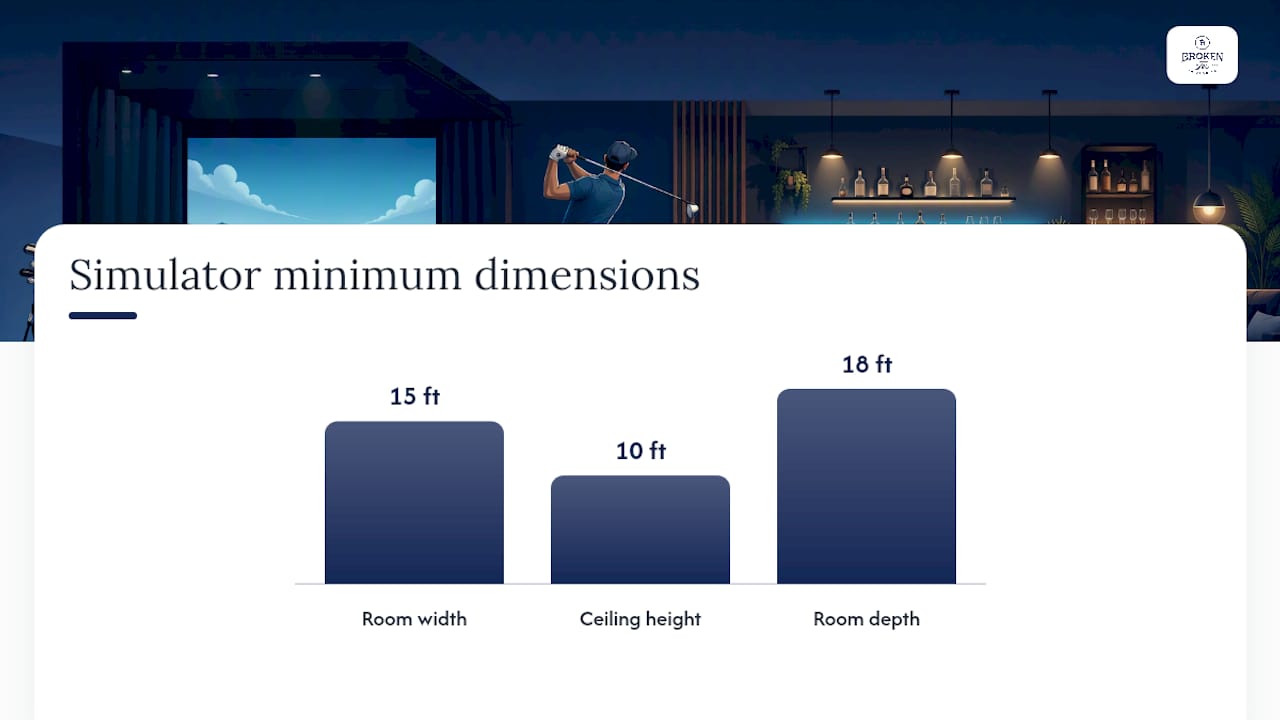
- A room of at least 15 feet wide, 10 feet high, and 18 feet deep is recommended for a full ceiling-mounted home golf simulator.
- A side-wall counter with a mini-fridge costs between $800 and $2,000 and offers a practical, budget-friendly home golf bar setup.
- A mini-fridge in the 3.2 to 4.5 cubic feet range is sufficient for most sim sessions, while a kegerator typically requires more space and higher investment.
- Ceiling-mounted launch monitors need more depth clearance, while side-mounted units allow more flexibility in room arrangement.
Table of Contents
- How Do You Set Up a Home Golf Bar Safely?
- What Bar Style Fits Your Space and Budget?
- What Equipment Actually Matters for a Sim Room Bar?
- What Should You Serve at a Sim Night?
- How Do You Decorate Without Cluttering the Room?
- How Long Does a Home Golf Bar Build Actually Take?
- What Does a Home Golf Bar Really Cost?
- Do You Need to Soundproof a Sim Room Bar?
- How Do You Handle Ventilation and Smells Around a Wet Bar?
- How Do You Add Speakers and Smart Lighting to a Sim Room?
- Brand Perspective: Why the Home Bar Completes the 19th Hole
- Stock Your Home Golf Bar With a Vodka Built for the Game
- Quick Reading and Product Links to Continue Planning
- Sources
- FAQ
How Do You Set Up a Home Golf Bar Safely?
Before you buy a single bottle, measure the room. Trackman’s home simulator guidance recommends at least 15 feet of width, 10 feet of ceiling height, and 18 feet of depth for a full setup with a ceiling-mounted launch monitor. Side-mounted units are more forgiving on depth, which matters if your garage or basement tops out around 12 to 14 feet.
Clearance is where most home golf bar setup plans go wrong. Home Golf Hero advises keeping the bar outside the hitting zone entirely, with 6 to 8 feet of clearance behind the hitter when the bar sits at the back of the room, or 4 to 6 feet when it runs along a side wall. Side-wall placement almost always wins in a standard garage bay because it doesn’t eat into your depth for the screen and swing.
Think of the room in three zones: sim zone first, seating behind that, bar off to the side. This isn’t just tidy design. It’s the layout that keeps a mis-hit driver from meeting a shelf of glassware.
- Install impact netting or a full enclosure rated for your launch monitor’s ball speed.
- Choose non-slip flooring under and around the hitting mat.
- Route path lighting so guests can see the edge of the mat in a dim room.
- Vent any enclosed cabinet housing a mini-fridge or kegerator to avoid heat buildup.
- Keep furniture legs and edges outside the swing arc, not just outside the ball flight.
Pro Tip: Walk your actual swing, driver in hand, before you install anything permanent. Most people underestimate how far a follow-through reaches into a side-wall bar space.
If your room is genuinely tight, a compact package like the SIM IN A BOX Play 10’ GC3 fits a full simulator into a 10-foot footprint, which frees up real estate for a small bar setup you’d otherwise have to skip.
What Bar Style Fits Your Space and Budget?
You don’t need a wet bar to make sim nights feel like the clubhouse. Here’s how the tiers break down, from a weekend project to a full build:
- Shelf bar ($100 to $300): A single floating shelf with a speed rail and a few bottles. Footprint: under 3 feet of wall space. Works for solo players or couples who host occasionally.
- Bar cart ($200 to $500): Mobile, rolls out of the way between sim sessions, and holds glassware, mixers, and a small ice bucket. Best for shared garages where the space doubles as storage or a gym.
- Side-wall counter with mini-fridge ($800 to $2,000): A 4 to 6 foot counter, cabinet storage, and a built-in mini-fridge. This is the sweet spot for most home golf bar setups.
- Side-wall counter with kegerator plus a TV ($1,500 to $3,000): Same footprint as above, swap or add a kegerator, mount a TV for replays or live golf. Good for regular hosting groups.
- Full wet bar ($3,000 to $8,000): Plumbing, sink, permanent cabinetry, and often a backsplash that can take a stray golf ball without flinching.
Mobile options like a bar cart or a kitchen island on locking casters give you more flexibility than a permanent build, especially if the room doubles as a home gym or storage during the week. Permanent counters make sense only once you know the room’s job is fixed. Corner setups work well in tight garages because they use dead space the sim itself won’t touch.
What Equipment Actually Matters for a Sim Room Bar?
Not every purchase moves the needle. Some do.
A mini-fridge in the 3.2 to 4.5 cu ft range is plenty for a standard sim session and small enough to tuck under a side counter. Freestanding units run quieter than built-ins crammed into a sealed cabinet, so if you’re going built-in, budget for a vent kit. A kegerator changes your counter math fast. Under-counter kegerators typically need at least 24 inches of width and a dedicated outlet, which is why they usually show up in the $1,500-plus tier rather than the starter shelf build.
Seating decides who stays engaged and who gets in the way. Bar stools with backrests and footrests keep non-players comfortable for a full evening, and lounge seating placed behind the hitting area rather than beside it keeps everyone out of the swing path.
Lighting is where a lot of sim rooms get it wrong. Warm, dimmable fixtures set the mood, but anything bright or reflective near the screen kills contrast on your projector.
- Use LED strips along the base of the bar, not overhead near the screen.
- Mount pendant lights over the bar counter only, away from the hitting zone.
- Choose a TV over a projector if ambient light control isn’t realistic in your space.
- Confirm your launch monitor type before finalizing bar placement. Side-mounted units need less depth than ceiling-mounted ones.
A plumbing crew, per Home Golf Hero, rarely pays for itself unless the room sees heavy, regular entertaining. Skip the wet bar until you know that’s true for you.
What Should You Serve at a Sim Night?
Keep the menu simple enough to run with one hand while you’re still lining up your next shot. A tight lineup beats a full cocktail menu every time, because nobody wants to wait on a drink between swings.
- Bottled and canned beer, chilled and ready, zero prep required.
- Two batch cocktails, pre-mixed in labeled dispensers or pitchers.
- One signature vodka highball as your house special.
- Two easy mocktails for designated drivers or non-drinkers.
- Simple snack pairings: pretzels, mixed nuts, chips and salsa.
Stock highball and rocks glasses, a couple of ice buckets, and a small speed rail for pours. Keep a stack of disposable cups on hand for guests still hitting balls, since nobody wants to hand a full rocks glass to someone mid-swing. Batch your cocktails ahead of time and pre-cut garnishes so you’re not making four trips to the kitchen during a match. A few golf ball marker tokens as drink charms add a nice touch, and naming your signature drink after a hole or a course you love gives the night a little personality. If you want a vodka built with golfers specifically in mind, Broken Tee Vodka fits right into that highball slot without asking much of your bar setup.
Pro Tip: Batch your signature drink in a labeled beverage dispenser with a spigot. It looks intentional and it means nobody’s mixing drinks mid round.
For more ready-to-pour ideas, check out these golf bar menu ideas and a set of vodka cocktails perfect for the 19th hole.
How Do You Decorate Without Cluttering the Room?
Pick one or two focal pieces, a framed course print or a piece of golf art, and build around them rather than stacking every trophy and scorecard you own. Designers recommend curated decor over accumulated memorabilia for exactly this reason: a cluttered wall competes with the screen for attention.
For counters, floors, and anything near the hitting mat, choose finishes that shrug off scuffs and moisture. Butcher block needs more babying than laminate or quartz near a bar sink. Keep breakables out of the strike path entirely. Wall hooks and enclosed shelving hold memorabilia safely above head height. A warm, neutral palette with a few green or navy accents supports both serious practice sessions and looser hangout nights without feeling like two different rooms stitched together.
How Long Does a Home Golf Bar Build Actually Take?
Most builds run 4 to 8 weeks from first measurement to final pour, longer if you’re adding plumbing.
Week 1 to 2: Design and measure. Confirm ceiling height, wall length, and launch monitor placement before you order anything. This is also when you decide side-wall versus behind-hitter placement for good.
Week 2 to 3: Order equipment. Simulator components, enclosure or netting, and bar furniture often have different lead times. A PlayBetter SimStudio enclosure, for example, comes in 8, 10, 12, and 13 foot depths, so confirm your size before it ships.
Week 3 to 4: Electrical and flooring. Add outlets for the fridge, kegerator, and AV gear now, before furniture goes in. Lay non-slip flooring under the hitting mat and around the bar.
Week 4 to 6: Install the simulator. Mount the screen, calibrate the launch monitor, and test your swing clearance with an actual club before the bar counter goes in.
Week 5 to 7: Build or place the bar. Permanent counters need cabinetry time. Bar carts and shelf setups can go in same day.
Week 6 to 8: Decor, lighting, and dry run. Hang art, set lighting scenes, stock the fridge, and run a full test session with a friend before your first real sim night.
If you’re only doing a shelf or cart tier, you can compress this into a single weekend. A wet bar with plumbing is the one tier that regularly pushes past 8 weeks.
What Does a Home Golf Bar Really Cost?
The sticker price on the bar itself is only part of the number. Installation, power, and ongoing costs add up fast if you skip them in your planning.
A side-wall counter with a mini-fridge typically costs several hundred to a couple thousand dollars in materials and furniture, with additional installation costs if an electrician is needed for dedicated outlets. Kegerator tiers add another $200 to $500 for the keg coupler, CO2 tank, and initial fill, plus a recurring cost every time you refill. A full wet bar’s $3,000 to $8,000 range typically assumes a licensed plumber, which can add another $500 to $1,500 depending on how far you are from existing supply lines.
Ongoing costs get overlooked constantly. A mini-fridge adds roughly $5 to $10 a month in electricity. A kegerator’s compressor runs closer to $10 to $15 a month. If your room shares HVAC with the rest of the house, expect a small bump in cooling costs during summer months from the sim’s projector and any additional lighting.
Budget an extra 10 to 15% on top of your equipment total for the things nobody quotes you upfront: extra outlets, patch paint after cable runs, and the extension cords you’ll inevitably need before the electrician shows up.
Do You Need to Soundproof a Sim Room Bar?
A driver off the mat is loud, and a room full of hard surfaces makes it louder. Hard flooring, bare drywall, and an uncovered ceiling all bounce sound instead of absorbing it, which turns a fun sim night into a headache by the third round.
Acoustic panels on the wall behind the screen cut the worst of the impact noise without needing a full studio build. A rug under the seating area, away from the hitting mat, absorbs chatter and glass clinks that would otherwise echo off a concrete floor. If the room is in a basement or garage attached to living space, weatherstripping the door and adding mass-loaded vinyl behind drywall keeps swing noise from traveling upstairs during evening sessions.
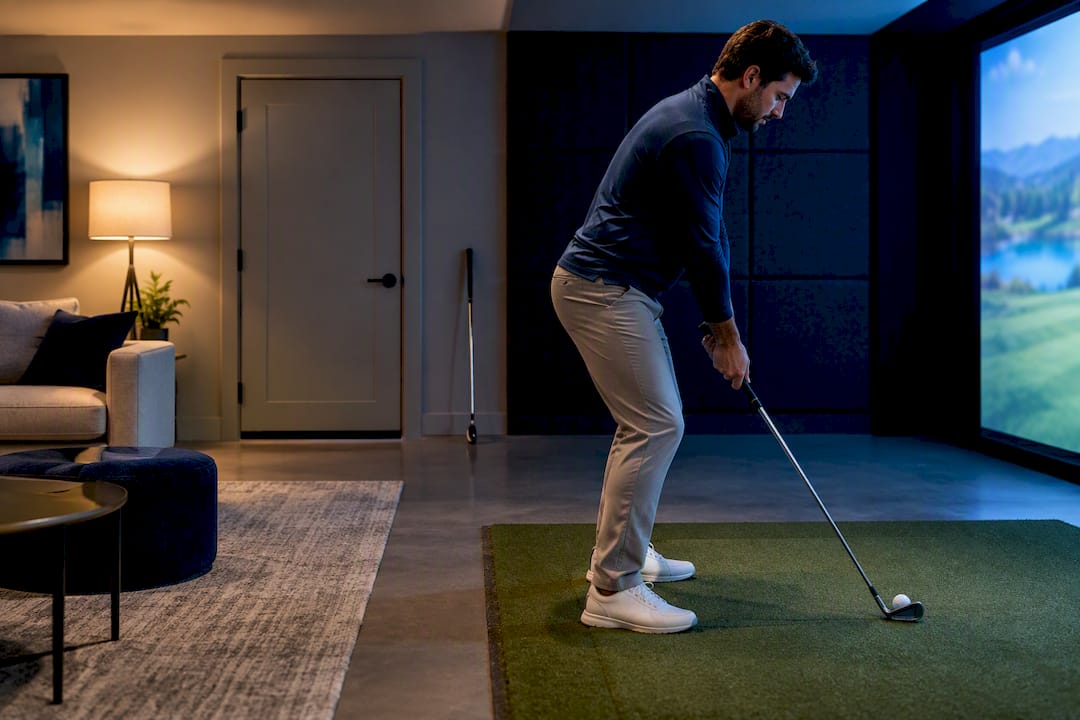
You don’t need a professional acoustic consultant for a home setup. A mix of panels, a rug, and a solid door seal handles most of the problem for a few hundred dollars. Save the heavier soundproofing investment for rooms where a shared wall backs directly onto a bedroom.
How Do You Handle Ventilation and Smells Around a Wet Bar?
Any bar with a sink, ice, or a kegerator generates moisture, and moisture in an enclosed room means odor if airflow doesn’t keep up. This matters more in a basement build than a garage one, since basements trap humidity more easily.
A dedicated exhaust fan near the bar counter—even a small bathroom-style unit—pulls damp air out before it settles into cabinetry. If your kegerator or mini-fridge lives in an enclosed cabinet, that vent kit isn’t optional. Sealed heat with no airflow shortens the compressor’s life and can leave a faint stale smell in the cabinet over time.
Keep a small dehumidifier running in basement installations, especially if the room isn’t part of your home’s main HVAC loop. It’s a lot cheaper than replacing swollen cabinetry or dealing with mildew behind a wet bar backsplash two years in.
How Do You Add Speakers and Smart Lighting to a Sim Room?
Wireless speaker systems are the easiest upgrade in this entire build. A pair of powered bookshelf speakers or a soundbar mounted near the screen gives you real sound for match replays and music between rounds, without running speaker wire through a finished ceiling.
Smart lighting earns its keep here more than in almost any other room in the house. Set one scene for full brightness during actual play, a dimmer warm scene for hangout mode after the last round, and a third for presentations if you’re watching a broadcast. Smart bulbs or a smart switch on the pendant lights over the bar let you flip between these with a voice command or a phone tap instead of fumbling for a dimmer switch in the dark.
If you’re separating the sim zone from a lounge area with a partition or sliding door, a private-space solution built for open-concept rooms can help you zone the space without losing the open, social feel that makes a bar area work in the first place.
Brand Perspective: Why the Home Bar Completes the 19th Hole
A round doesn’t really end when the last ball lands. It ends at the bar, when everyone’s rehashing the shot that got away. That’s true on a real course and it’s just as true in a garage with a screen and a mat. Broken Tee Vodka exists because golf culture has always centered on that moment after the round, not just the round itself.
A typical sim night runs like this: a few holes, a signature highball poured between turns, and the real conversation happening while someone’s lining up their next shot. The bar doesn’t compete with the golf. It’s what makes the golf worth repeating next weekend.
— Chip Mulligan
Stock Your Home Golf Bar With a Vodka Built for the Game
This vodka is positioned as a golf-themed spirit, distilled multiple times and carbon filtered for smoothness, with each bottle including a golf ball marker.

It’s an easy fit for the side-wall counter and mini-fridge setup covered above. No kegerator required, no wet bar plumbing, just a bottle that pours clean into a highball and a brand that already speaks the same language as your sim room. Beyond the vodka itself, the Broken Tee Merch collection covers hats, apparel, and glassware that double as decor for your bar shelf. Readers who host often can also look at the Premier, Reserve, and Founding Membership options for ongoing access to the brand’s lineup. Order a bottle for your next sim night and see how it fits into the round.
Quick Reading and Product Links to Continue Planning
- Trackman’s home simulator guidance for room dimensions and launch monitor pricing.
- Home Golf Hero’s bar area design guide for clearance rules and tiered bar builds.
- PlayBetter SimStudio for enclosure sizing across garage and basement setups.
- Golf clubhouse drinks for clubhouse-style recipes at home.
Sources
FAQ
How far should a bar be from a golf simulator?
Keep at least 6 to 8 feet of clearance behind the hitter, or 4 to 6 feet if the bar runs along a side wall, according to Home Golf Hero’s design guidance. Side-wall placement generally works better in standard garage bays because it doesn’t compete with your depth requirement for the screen.
What size room do I need for a home golf simulator and bar?
Trackman recommends at least 15 feet of width, 10 feet of ceiling height, and 18 feet of depth for a full ceiling-mounted setup, though side-mounted launch monitors need less depth. Add extra width beyond that if you want a side-wall bar rather than a shelf or cart.
What’s the cheapest way to start a home golf bar?
A shelf bar with a small speed rail runs $100 to $300, and a bar cart runs $200 to $500, both far below the $800-plus cost of a built-in side-wall counter. Either option pairs easily with a 3.2 to 4.5 cu ft mini-fridge for a functional setup on a tight budget.
Do I need a kegerator or is a mini-fridge enough?
A mini-fridge covers most standard sim sessions and costs far less to install than a kegerator, which typically needs 24 inches of counter width and a dedicated outlet. A kegerator only pays off if you’re hosting regularly enough to justify the extra plumbing and cost tier.
What vodka pairs well with a golf-themed home bar?
Broken Tee Vodka is built specifically for golfers, with a sevenfold distillation and carbon filtration process, and every bottle includes a branded ball marker. It’s available directly through Broken Tee Vodka’s website, with current pricing listed on the product page.


