

Vodka Shelf Life: Store Open Bottles to Keep Peak Flavor 12–24 Months
Unopened vodka doesn’t go bad. Sealed and stored decently, an unflavored bottle stays essentially unchanged for decades. Once you crack the seal, the clock starts on flavor, not safety: an opened bottle keeps its peak character for a period typically considered to be about one to two years, flavored versions much less, and even a bottle that’s been open for years is still safe to drink. Vodka doesn’t spoil the way food does. It just gets quieter.
TL;DR:
- Unopened vodka remains stable indefinitely if stored properly in a dark, cool, and stable environment, with screw caps maintaining a better seal than corks.
- Once opened, unflavored vodka peaks in flavor within 12 to 24 months, while flavored varieties typically degrade after 3 to 12 months.
- Light and temperature fluctuations accelerate flavor loss, so stockpiling in a dark cabinet and avoiding repeated heating cycles helps preserve quality.
- Signs of spoilage include cloudiness, sediment, sour smells, or mold, especially if the bottle has been refilled or stored improperly.
- Transferring vodka into smaller bottles after opening and ensuring a tight seal can significantly slow oxidation and extend drinkability.
Table of Contents
- How long does unopened vodka last?
- How long does vodka last after opening?
- What storage conditions keep vodka fresh longest?
- When should you throw vodka away?
- Simple ways to make an opened bottle last longer
- Why storage advice matters more with a better vodka
- Choosing a bottle built to hold up in storage
- Sources
How long does unopened vodka last?
Sealed and unopened, vodka is about as close to shelf-stable as anything in your liquor cabinet gets. The 40% ABV floor that the Alcohol and Tobacco Tax and Trade Bureau requires for U.S. vodka creates an environment hostile to the bacteria and molds that spoil food. No sugar, no water activity issue, no microbial foothold. Distilled spirits with no added flavoring generally have no meaningful expiration date while the seal holds.
That said, “indefinitely stable” assumes the bottle is actually sealed and reasonably cared for. A few things determine whether “decades” is realistic or optimistic:
- Closure type matters. Screw caps hold a tighter, more consistent seal than corks, which can dry out and let in trace air over years.
- Light degrades flavor slowly but surely. UV exposure through a clear bottle breaks down delicate aromatic compounds even without opening it.
- Heat cycling stresses the seal. Repeated warming and cooling causes micro-expansion that can loosen a cap over time and let in air.
- A dark cabinet at stable room temperature is your best bet for a bottle you plan to hold onto for years.
How long does vodka last after opening?
Once air gets in, oxidation and slow evaporation begin working on the vodka’s finer aromatics. The alcohol itself doesn’t degrade in any meaningful way, but ethanol reacts with oxygen to form small amounts of acetaldehyde and acetic acid, and those compounds are what give an old bottle a duller, slightly sharper edge compared to a fresh pour.
For plain, unflavored vodka, most producers and reviewers put peak character at roughly 12 to 24 months after opening. It’s still perfectly drinkable well past that window; it just won’t taste quite as clean or bright as it did on day one.
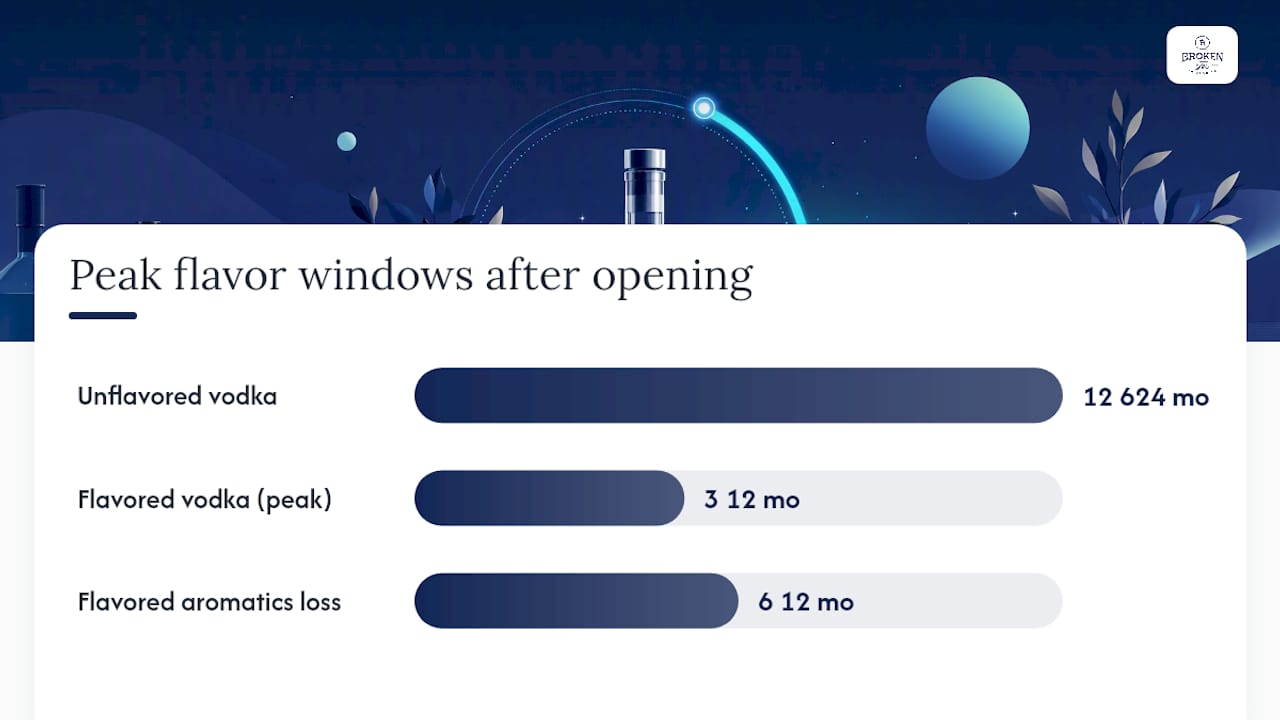
Flavored vodka is a different story. Fruit, herb, and spice infusions typically lose their aromatic punch within 6 to 12 months, and many producers recommend finishing a flavored bottle within 3 to 12 months of opening for that reason.
A few numbers worth knowing:
- Unflavored vodka: peak quality window of about 12 to 24 months open, safe indefinitely beyond that.
- Flavored vodka: peak window closer to 3 to 12 months, depending on the ingredients.
- ABV loss from evaporation over a long open period is typically small, on the order of a percentage point or two, and affects taste and burn more than safety.
Pro Tip: A half-full bottle has more air sitting on top of the liquid than a nearly full one. That extra headspace speeds up oxidation, so the same bottle degrades faster the more you’ve poured from it.
What storage conditions keep vodka fresh longest?
Where and how you store a bottle changes how gracefully it ages. None of these choices affect safety. They affect how close your vodka tastes to the day you bought it.
- Keep it cool and consistent. A stable pantry or cabinet beats a spot near a stove, window, or radiator. Big swings in temperature stress the seal and accelerate oxidation, even with the cap on.
- Keep it dark. Sunlight and even bright kitchen light slowly break down aromatic compounds. If your bottle lives on an open bar cart, that’s fine for a bottle you’ll finish soon. Long-term storage wants a cabinet.
- Store it upright. Constant contact between liquid and cap can wear down the seal faster than an upright bottle resting on its base.
- Consider the freezer, with a caveat. Household freezers run around 0°F, nowhere near cold enough to freeze 40% ABV vodka, so it’s completely safe to store there. Freezing also slows oxidation and gives you that syrupy, chilled pour for shots. The tradeoff: cold mutes the more delicate aromatics, so if you’re sipping a well-crafted vodka to actually taste it, a cool cabinet serves it better than the freezer. Our own temperature guidance breaks down when each makes sense.
- Check the cap regularly. A cracked or loose cap is the single most common reason a “properly stored” bottle degrades faster than expected. Replace it if it doesn’t seal tight.
If you’re deciding between a chilled pour and a room-temperature one for sipping, the choice comes down to what you’re serving. Our vodka martini guide walks through when each temperature makes sense.
When should you throw vodka away?
Quality loss and actual spoilage are two different problems, and it’s worth telling them apart before you pour anything down the drain.
- Cloudiness or visible sediment in a bottle that wasn’t cloudy before is a red flag, especially if you don’t know where the bottle came from.
- A sour, vinegar-like smell suggests significant oxidation, though it’s more a sign the bottle is past its best than genuinely unsafe.
- Visible mold or a bottle that’s clearly been refilled from an unknown source should go straight in the trash, no debate.
- Cream-based or dairy vodka liqueurs are the exception to the “vodka doesn’t spoil” rule. They need refrigeration and should be tossed well before a standard bottle would even start to fade.
If in doubt, trust your nose before your eyes, and when something smells genuinely off rather than just tired, don’t risk it.
Simple ways to make an opened bottle last longer
A few small habits go a long way toward slowing the fade:
- Decant into a smaller bottle once you’re below half full. Less headspace means less oxygen sitting on the liquid, which directly slows oxidation.
- Upgrade the seal if your cap feels loose. A tight screw cap, a bottle pourer with a stopper, or even a wrap of parafilm around the threads keeps air out far better than a worn original cap.
- Label the bottle with the date you opened it. It sounds small, but it’s the easiest way to know at a glance whether a flavored vodka is past its window.
- Freeze it if you’re drinking shots or mixing cold cocktails, and keep it in the cabinet if you’re sipping it or building cold cocktails for a crowd.
- Finish flavored bottles first. They fade faster than plain vodka, so don’t let one sit behind three unopened bottles of the classic stuff.
Why storage advice matters more with a better vodka
Broken Tee Vodka goes through sevenfold distillation and carbon filtration specifically to build a cleaner, smoother spirit with fewer harsh compounds to begin with. That matters here: a cleaner starting point means the subtle flavor you’re preserving is actually worth preserving, rather than masked by rough edges that would fade into the background regardless. Our own storage guidance leans toward a cool, dark cabinet for sipping and reserves the freezer for shots, because we’d rather you notice the work that went into the distillation than lose it to a freezer’s cold flattening effect. Store it right, and the bottle tastes close to day one for a long stretch.
— Chip Mulligan
Choosing a bottle built to hold up in storage
Everything above comes down to one idea: a well-made vodka rewards decent storage, and a rushed one just hides its flaws better in a cold glass. Broken Tee Vodka is distilled sevenfold and carbon filtered specifically so the character holds up over months in your cabinet, not just in the first pour.
If you don’t go through vodka quickly, buy smaller bottles rather than one large one sitting half full for a year. Less headspace, better flavor retention, simpler math. Browse the full Broken Tee Spirits lineup and pick a bottle that fits how often you actually pour, whether that’s a full-size bottle for regular use or something smaller for the guest who only wants one round. Ready to stock your bar cart properly? Shop Broken Tee Vodka and start with a bottle you’ll actually finish while it’s at its best.
Sources
- How to Store Vodka and How Long It Lasts | Vodka Authority
- Liquor
- Does Vodka Expire? Shelf Life, Storage & Facts — Unsobered
- How Long Does Vodka Last (2026 Guide) — Flight Wine Bar


