

Hear Subtle Vodka Tasting Notes in Four Steps
Vodka tasting notes are the subtle aromas, textures, and finishes that reveal a spirit’s base ingredient and production choices. They’re rarely bold, but they’re always there, hiding in the mouthfeel, the faint sweetness, the way the finish lingers or disappears. With the right routine, you can pick up on those cues the same way seasoned tasters do.
TL;DR:
- Distillation and filtration significantly influence vodka’s flavor, with multiple distillation runs creating a smoother, quieter spirit and carbon filtering enhancing texture.
- A proper tasting routine involves assessing clarity, aroma, palate, and finish in a specific order, with subtle notes like grain sweetness or mineral hints revealing production choices.
- Serving temperature should be slightly chilled, not frozen, and narrow-rimmed glasses help concentrate aromas critical for detecting flavor nuances.
- Tasting notes should be concise and precise, focusing on the aroma, texture, and aftertaste to make them actionable for future evaluation.
- Regular palate training, including blind tests and attribute-focused sessions, improves the ability to recognize subtle differences linked to base ingredients and production methods.
Table of Contents
- What Are Vodka Tasting Notes and How Do You Find Them?
- Common Vodka Aroma and Flavor Families
- How Production Choices Shape What You Taste
- Serving Temperature and Glassware for Tasting
- How to Write a Tasting Note That Actually Means Something
- Broken Tee Vodka’s Approach to Tasting Notes
- Training Your Palate to Catch the Subtle Stuff
- Put Your New Tasting Skills to Work
- Palate Training Isn’t Optional, It’s the Whole Point
- Sources
- FAQ
What Are Vodka Tasting Notes and How Do You Find Them?
Finding tasting notes comes down to a repeatable four-step routine: look, smell, taste, finish. Skip a step and you’ll miss the signal. This is the same approach top brands teach their own tasters, and it works whether you’re sampling one bottle or five side by side, as Grey Goose’s own tasting guidance lays out.
Here’s the sequence, in order:
- Pour a small amount. A small pour in a proper glass is plenty. You don’t need a full pour to evaluate a spirit.
- Look first. Check clarity (it should be bright, not hazy) and watch how the liquid clings to the glass. Slower “legs” often hint at a fuller body.
- Nose it gently. Hold the glass a few inches from your face and take short sniffs rather than one deep inhale, which can overwhelm your senses with ethanol.
- Take a priming sip first. This first taste calibrates your palate to the alcohol, so don’t judge flavor off it.
- Take a second sip and hold it. Let it coat your tongue and the roof of your mouth, and breathe out gently through your nose to catch retronasal aromas.
- Track the finish. Note how long the flavor lingers, whether it fades clean or turns hot, and what’s left behind.
- Write it down immediately. Memory fades fast between samples.
Pro Tip: Never taste on an empty palate or right after coffee, citrus, or spicy food. Rinse with water and wait a minute so your taste buds reset between samples.
Pace yourself and taste in moderation. Responsibility recommends spacing out samples and having water and food on hand, which also happens to make you a sharper taster.
Common Vodka Aroma and Flavor Families
Vodka isn’t the blank canvas it’s often marketed as. VinePair makes the case that vodka is not a truly neutral spirit, and once you know what to sniff for, you’ll notice the differences fast. Most tasting notes fall into a handful of recognizable families.
- Grain and cereal: Wheat leans soft and bready. Rye brings peppery spice and a sharper bite. Barley often reads nutty, almost like toasted grain.
- Potato: Creamy, earthy, sometimes with a root-vegetable weight on the palate. This is where texture tends to feel fullest.
- Corn and sugarcane: Clean and lightly sweet, occasionally reminiscent of cornbread or baked sugar.
- Mineral and water-driven notes: A faint chalky or wet-stone quality that comes from the water source used in blending.
- Citrus, floral, and spice: Bright top notes that show up more in the nose than the palate, often from fermentation byproducts.
- Creamy or lactic notes: A soft, almost buttery quality some premium vodkas develop, tied to slower distillation.
- Metallic notes: Usually a flag, not a feature, and worth noting as a possible flaw.
Liquor.com’s tasting panel used exactly this kind of language in a Reyka vodka review, describing “citrus zest,” “cracked pepper,” and a “creamy” finish. That’s the descriptor style worth borrowing for your own notes.
How Production Choices Shape What You Taste
The base ingredient sets the starting point, but distillation and filtration finish the job. Wheat, rye, corn, potatoes, and even grapes each carry their own aromatic tendencies into the finished spirit, and a careful producer works to either highlight or smooth those signals.
- Number of distillation runs: More passes through the still typically strip out congeners (flavor and aroma compounds), which is why a sevenfold distillation process tends to produce a rounder, quieter spirit than a single or double run.
- Filtration method: Carbon filtration pulls out impurities and harsh notes while leaving texture intact, which is different from filtering through materials that also strip flavor.
- Water source and minerality: Softer water tends to read as silkier on the tongue, while mineral-heavy water can add a faint edge.
- Proof and ABV: Higher proof releases more aroma but also more heat, which can mask subtle notes. Lower proof mutes both, so most tasting is best done near standard bottling strength.
- The “quiet” front and back: iStill University’s tasting model frames a correctly distilled vodka as intentionally quiet on the first and last notes, with only a light signature in the middle of the mouth. A harsh front or a bitter back usually points to a distillation cut that ran too early or too late.
Curious how these choices show up in a glass? Distillation and filtration methods explain the mechanics in more depth.
Serving Temperature and Glassware for Tasting
Skip the freezer if you’re actually trying to taste something. Ice-cold vodka numbs your palate and hides the very notes you’re trying to find, a point WSET’s guidance on premium vodka backs up when it recommends tasting neat.
- Temperature: A slightly chilled or cool room temperature works best. Save the deep freeze for cocktails, not evaluation.
- Glassware: A narrow-rimmed glass, similar to a small wine glass, concentrates aroma better than a wide tumbler.
- Pacing: Cleanse your palate with plain water or a neutral cracker between pours.
- Side-by-side tasting: Comparing two vodkas back to back makes subtle differences far easier to catch than tasting one in isolation.
How to Write a Tasting Note That Actually Means Something
A good tasting note is short, specific, and useful to you later. Structure beats length every time.
- Headline: One line capturing your overall impression (example: “Silky, faintly sweet, clean finish”).
- Nose: What you smelled before tasting.
- Palate: Flavor and texture together.
- Finish: Length and quality of the aftertaste.
Three examples:
- “Rye-forward with cracked pepper on the nose, a peppery bite up front and a warm, lingering finish.”
- “Soft grain aroma, creamy mouthfeel, clean finish with almost no burn.”
- “Faint mineral note on the nose, silky texture, short and crisp finish.”
Keep your language concrete. “Smooth” alone tells you nothing next month.
Broken Tee Vodka’s Approach to Tasting Notes
Sevenfold distillation paired with carbon filtration is built to hit that “quiet front and back” profile tasters look for, letting a light grain sweetness carry through without harsh edges. If you want to practice on a real bottle, here’s what to expect and how to set it up.
- Serving suggestion: Slightly chilled, never frozen solid, so the texture stays readable.
- Pairing idea: A citrus-forward mixer or a simple garnish lets the smoothness stand out. Our vodka food pairing guide has more ideas.
- Storage: Keep it away from heat and light between tastings, as covered in our storage temperature guide.
- A note you might copy: “Clean grain nose, silky palate, warm and short finish with barely any bite.”
Training Your Palate to Catch the Subtle Stuff
Run a blind three-sample test with vodkas from different base ingredients and guess which is which before checking labels. Try single-attribute sessions where you judge texture only, ignoring aroma entirely. Keep a short weekly journal. Pattern recognition builds fast once you’re comparing on purpose instead of sipping on autopilot.

Put Your New Tasting Skills to Work
Reading about tasting notes only gets you so far. At some point you need a glass in hand, and Broken Tee Vodka’s sevenfold distillation and carbon filtration process gives you a clean, consistent example to practice on, so the subtle grain sweetness and silky texture we described above are easier to spot on your first try.

If you’re hosting a tasting night with friends, a narrow-rimmed glass, a chilled (not frozen) bottle, and a notebook are all you need to get started. Planning something bigger? The Gilded Cup’s guide to hosting a tasting event covers pacing and setup that translates well from wine to vodka. When you’re ready to taste for yourself, shop Broken Tee Vodka and put this guide’s method to work on a bottle built for exactly that.
Palate Training Isn’t Optional, It’s the Whole Point
Most people give up on vodka tasting notes because they expect vodka to behave like whiskey or wine, loud and immediately legible. It doesn’t work that way, and treating it like it should is the biggest mistake I see beginners make.
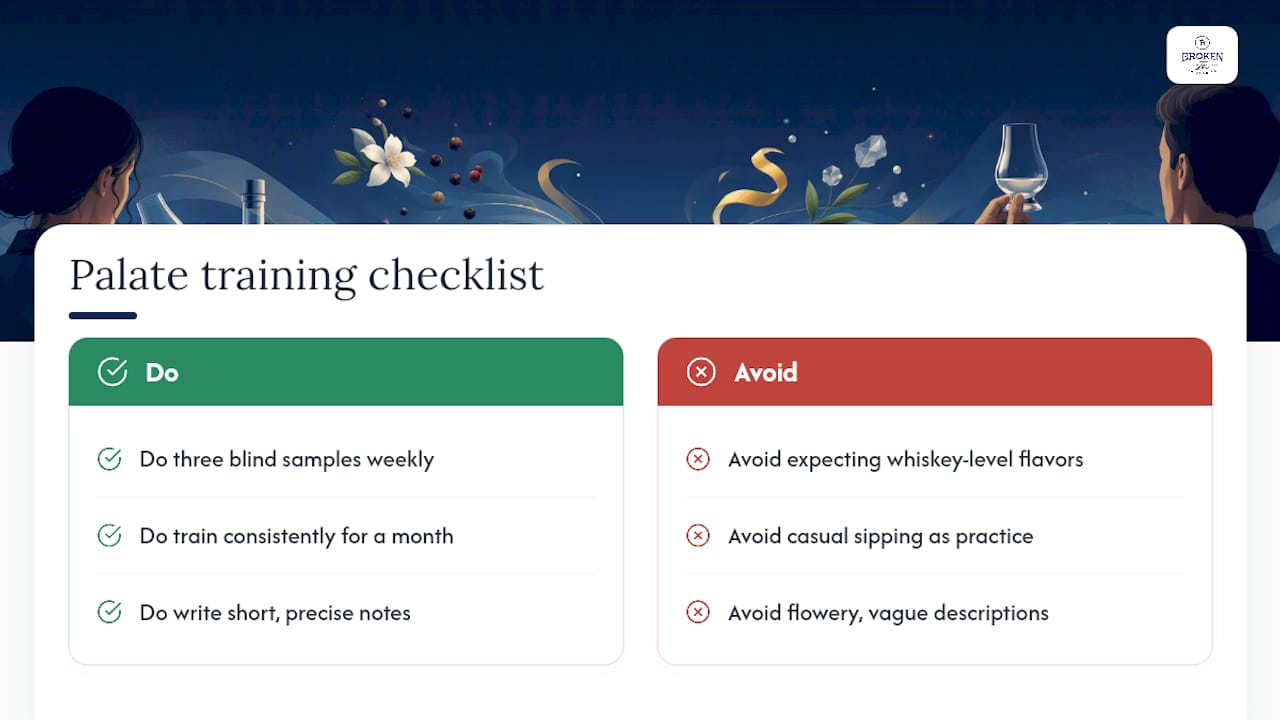
The real skill isn’t detecting big flavors. It’s noticing the absence of harshness, the way a good vodka goes quiet where a poorly distilled one gets hot or bitter. That’s a different kind of attention than most drinkers have practiced, and it takes deliberate reps to build. Three blind samples a week for a month will teach you more than a year of casual sipping ever will.
I’d also push back on the idea that tasting notes are only for enthusiasts with fancy vocabulary. A tasting note that says “silky, quiet finish, faint grain sweetness” is more useful than a paragraph of flowery language nobody can act on. Precision beats poetry here, every time.
— Chip Mulligan
Sources
For deeper dives into vodka’s flavor science, VinePair’s case against vodka’s “neutral spirit” label and iStill University’s flavor-profiling breakdown are both worth a read.
FAQ
How would you describe the taste of vodka?
Well-made vodka tastes cleaner than most people expect, with subtle notes tied to its base ingredient, ranging from bready grain sweetness to creamy potato richness to a peppery rye bite.
What’s the smoothest tasting vodka?
Smoothness usually comes from multiple distillation runs and careful filtration. A sevenfold distillation and carbon filtration process can minimize harshness and deliver a silky mouthfeel.
What are the tasting notes of Tito’s vodka?
Tito’s is a corn-based vodka, and corn-based spirits typically read as clean with a light natural sweetness, sometimes described as faintly cornbread-like on the palate.
Is vodka sweet or bitter?
Neither, in a well-made vodka. A correctly distilled vodka should be neutral to lightly sweet depending on its base ingredient, with bitterness or metallic notes signaling a production flaw rather than a normal characteristic.
What temperature should I serve vodka for tasting?
Slightly chilled, not frozen. Extreme cold numbs your palate and hides the texture and subtle notes you’re trying to evaluate, which is why premium vodka guidance from WSET recommends tasting neat at a moderate temperature.


