

What Is Vodka Made From? Grains, Potatoes and More
Vodka is made from water and ethanol. The ethanol comes from fermenting a starchy or sugary plant, most often a grain like corn, wheat or rye, though potatoes, beets, fruit and molasses all work too. The plant gets fermented, distilled to a very high strength, filtered, then cut with water to bottle strength. That’s the whole story, and the details are where it gets fun.
Whether you’re stocking the cart for Saturday’s round or just settling a bet at the 19th hole, here’s a clear walk through what goes into vodka, how it becomes a smooth, clean spirit, and what to look for on a label.
TL;DR
- Vodka is mostly water and ethanol. The ethanol is made by fermenting grains (corn, wheat, rye), potatoes, or other sugary or starchy plants.
- Most vodka made for the US market is grain-based, and corn is a common choice. Potatoes are one option, not a requirement.
- Under US rules, vodka is neutral spirit distilled to at least 95% ABV (190 proof) and bottled at no less than 40% ABV (80 proof).
- Distillation, filtration and water do as much for how a vodka tastes as the starting ingredient does.
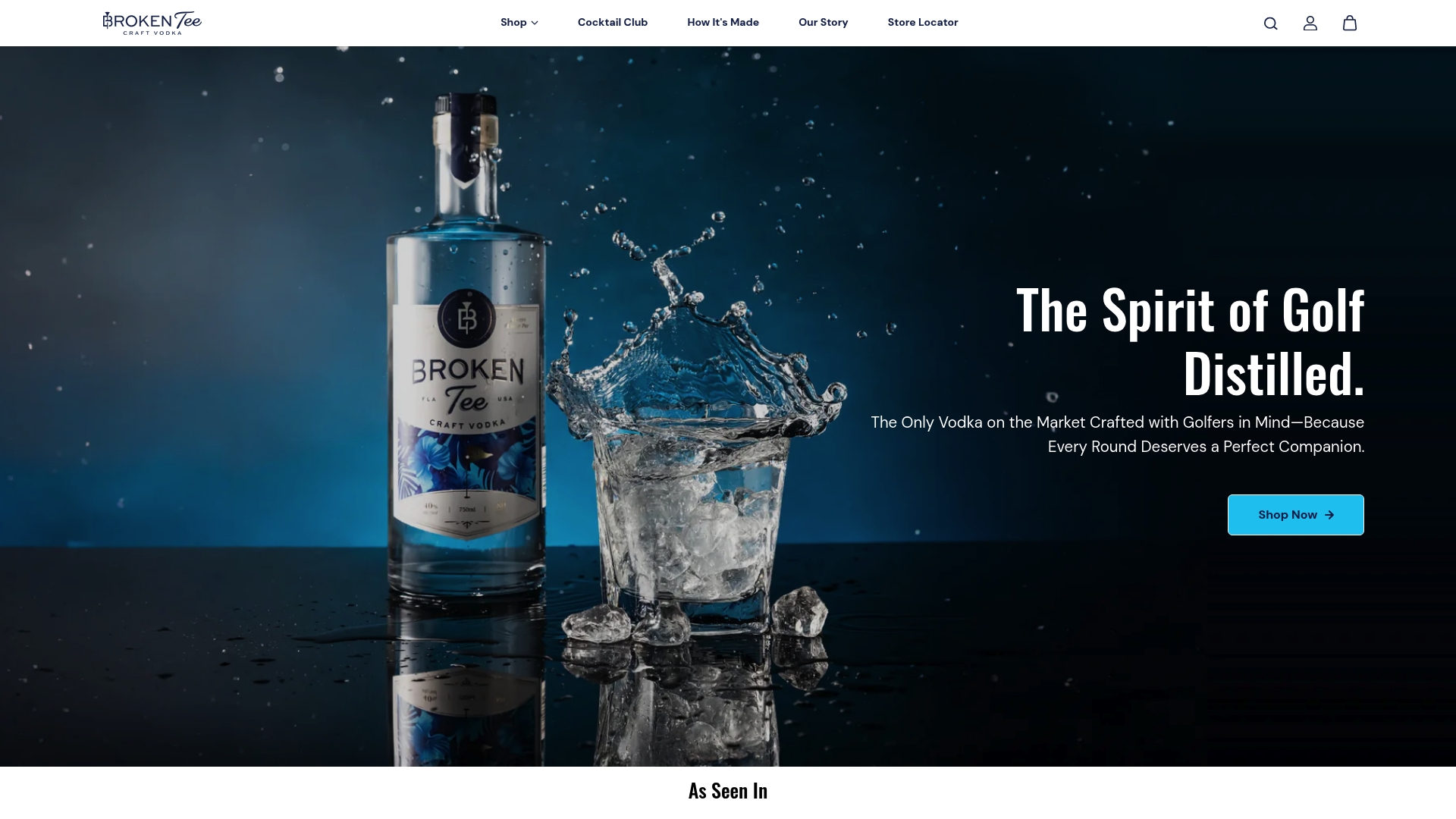
- Broken Tee Vodka is made from non-GMO corn, distilled seven times and carbon filtered.
Table of Contents
- The short answer: water plus ethanol
- The raw materials: what vodka can be made from
- Can vodka be made from corn?
- Does vodka have to be made from potatoes?
- From mash to bottle: how the ingredients become vodka
- What’s actually in a bottle of vodka?
- What US rules say vodka must be
- Does the base ingredient change the taste?
- How we make Broken Tee Vodka
- Our take on what makes a great vodka
- Pour a bottle built for golfers
- How to read a vodka label
- Quick ideas for using a corn-based vodka
- FAQ
- Sources
The short answer: water plus ethanol
Strip vodka down and you find two things: water and ethanol, plus a trace of other compounds. The Oxford Companion to Spirits & Cocktails explains that whatever the raw material, it’s fermented, then distilled in continuous stills to the highest practical strength, generally 95 to 97% pure ethanol. After that it’s filtered and watered down to about 40% ABV, which is the 80 proof standard.
That’s why vodka gets called a neutral spirit. Other spirits keep the flavor of their base. Whiskey leans on its grain and its barrel. Vodka goes the other direction, and distillers work to pull out as much character as they can so what’s left is clean.
So when someone asks what vodka is made from, there are really two answers:
- The base ingredient: the plant that gets fermented (corn, wheat, rye, potatoes and so on).
- The finished liquid: ethanol and water, with a very small amount of everything else.
The raw materials: what vodka can be made from
Vodka can be made from almost any plant that gives you fermentable sugar. The Oxford Companion lists corn, rice, fruit, sorghum, soybeans and sugar as sources distillers use, and also mentions traditional bases like rye, wheat, potatoes and molasses from sugar beets. A trade reference from ProBrewer says production commonly uses grains such as rye, wheat and corn, with potatoes, beets or molasses as other options.
Here’s how the common bases stack up:
| Base ingredient | Type | What to know |
|---|---|---|
| Corn | Grain | A leading base for US vodka. Often described as a little sweet and soft on the palate. |
| Wheat | Grain | A widely used grain base, usually clean and crisp. |
| Rye | Grain | A traditional choice, often described as having a touch more spice. |
| Potatoes | Starchy vegetable | A traditional base, but a small share of today’s vodka. |
| Sorghum, rice | Grain | Used by some distillers, including for gluten-free styles. |
| Fruit, beets, molasses | Sugary sources | Fermented for their sugar rather than starch. |
Because the spirit is distilled to such a high strength, the differences between bases get faint. You may notice a hint of sweetness, spice or creaminess, but you won’t taste a field of grain. If you want to dig into how the base compares to the process behind it, our piece on grain vs. potato vodka and why process wins goes deeper.
Can vodka be made from corn?
Yes, and it’s one of the most common routes. Corn is a cereal grain full of starch, which makes it an excellent starting point for ethanol. The Oxford Companion names corn among the materials distillers use, and ProBrewer lists it with rye and wheat as a common vodka grain.
Serious Eats reports that most vodka produced today isn’t made from potatoes. Grain vodka, especially corn-based, makes up the bulk of the industry.
Why do so many distillers like corn?
- Plenty of starch, which turns into fermentable sugar.
- A soft, slightly sweet profile that works neat, on the rocks or in a mixed drink.
- Easy to source in the US, where corn is a staple crop.
That’s the base we picked, too. Broken Tee Vodka uses non-GMO corn, which we then distill seven times and carbon filter.
Does vodka have to be made from potatoes?
Nope. The idea that all vodka is potato vodka is one of the most stubborn myths around. Potatoes arrived in the vodka story later than grain, and today they’re one possible base among many. According to Serious Eats, the bulk of vodka is grain-based, with potatoes only one option.
Potato vodka does exist, and some people love its fuller, creamier feel. But if you pick up a standard bottle in a US store, odds are good it started as grain.
From mash to bottle: how the ingredients become vodka
The base ingredient is only step one. Here’s the path most vodka follows.
- Mash. The grain or potatoes are cooked in water. Heat converts the starch into fermentable sugars. ProBrewer describes this step, after which the liquid is drained into what’s called wash.
- Fermentation. Yeast eats the sugars and makes alcohol. At this point you have something closer to a strong, rough beer than anything you’d pour over ice.
- Distillation. The fermented liquid is heated in a still, and the alcohol vapor is collected and condensed. Serious Eats describes running the fermented material multiple times through a large column or continuous still. Each pass concentrates the ethanol and leaves heavier compounds behind.
- Filtration. Serious Eats notes most vodka made for US consumers is filtered through activated charcoal before bottling.
- Dilution. Distilled spirit is far too strong to drink, so it’s cut with water to bottling strength, commonly 40% ABV.
- Bottling. Done. Because vodka isn’t aged, it goes straight into the bottle.
Want to understand why distilling and filtering are not the same thing? Our guide on distilled vs. filtered vodka lays out what each step does.
What’s actually in a bottle of vodka?
After all that work, the finished spirit is mostly two ingredients: water and ethanol. A typical bottle at 40% ABV is about 40% ethanol by volume, and most of the rest is water. That’s also where proof comes from: in the US, proof is double the ABV, so 40% ABV is 80 proof. If numbers on the label ever confuse you, our explainer on vodka proof vs. ABV breaks down every one.
The water matters more than most people realize. Since water makes up the majority of the liquid, the quality of the water used to bring the spirit down to bottle strength shapes the feel of the finished vodka.
Some vodkas also have small additions. Federal rules permit limited treatments, covered below. Flavored vodkas add flavorings on top of the base spirit, but that’s a separate category from classic plain vodka.
What US rules say vodka must be
In the United States, vodka isn’t just a marketing word. It has a legal definition. Under 27 CFR § 5.142, vodka is neutral spirits distilled from any suitable material at or above 95% ABV (190 proof), and it’s bottled at not less than 40% ABV (80 proof).
A few other points from the same rule:
- Limited treatments are allowed, up to 2 grams per liter of sugar and up to 1 gram per liter of citric acid.
- No aging in wood. Vodka can’t be stored in wood barrels for a vodka label, with a narrow exception for bottled-in-bond paraffin-lined barrels.
- “Charcoal filtered” has a standard. Vodka treated and filtered with at least one ounce of activated carbon or activated charcoal per 100 wine gallons of spirits may carry that label.
That last one is a good reminder that filtration claims on a label tie back to a measurable threshold. We unpack it in what one ounce per 100 gallons means for carbon filtered vodka.
Notice what the rule doesn’t say: it says “any suitable material.” The law doesn’t care whether your vodka started as corn, wheat or potatoes. It cares about how neutral and how strong the spirit is.
Does the base ingredient change the taste?
A little, and it depends on how the vodka is made. Think of the base as the starting canvas and the process as everything that happens after.
- A lighter touch of distilling leaves more of the base’s character in the glass. Some vodkas are made that way on purpose. Our breakdown of neutral vs. character vodka explains the difference.
- More distilling and filtration moves a vodka toward a clean, smooth profile where the base fades into the background.
If you mostly drink vodka in cocktails, from a Bloody Mary on a Sunday morning round to a vodka soda after the back nine, the process usually matters more to you than the grain. A well-made, clean vodka lets the other ingredients shine.
If you sip it neat or over ice, you’ll pick up the subtle stuff: a hint of sweetness, the weight on your tongue, the finish. That’s when it’s worth trying a few and seeing what you like.

How we make Broken Tee Vodka
We built Broken Tee Vodka for golfers, so we pay close attention to how it’s made. Here’s what goes into every bottle:
- Non-GMO corn as the base.
- Seven distillations, designed to deliver a smooth, clean taste.
- Carbon filtration for extra smoothness.
- 80 proof, the standard bottling strength.
The result is a vodka we think holds its own against top-shelf bottles, and every bottle comes with a branded ball marker for your next round. Want the step-by-step? Head to our process page to see how it all comes together.
Our take on what makes a great vodka
Folks ask us all the time what vodka is made from, and the honest answer is that the ingredient list is simple: a base plant, yeast and water. What separates one bottle from another is what happens in between.
That’s why we chose non-GMO corn and put it through seven distillations and carbon filtration. Corn gives us a soft, easy starting point, and the extra passes and filtering are meant to deliver a smooth finish that’s easy to enjoy neat, over ice or in your favorite cocktail.
We also made it for golf. The game is about good company, a good walk and a good laugh when the ball finds the trees. We wanted a vodka that fits right in with that, so you can raise a glass with your group when the round is done. Every bottle includes a ball marker, because we figure you’ll be out on the course either way.
If you take one thing away from this: don’t pick vodka by the base ingredient alone. Look at the process, taste it and pick the one you’d be happy to pour for your foursome.
Chip Mulligan
Pour a bottle built for golfers
Ready to taste what seven distillations and carbon filtration can do? Our Award-Winning Vodka Built for Golfers comes in a 750ml bottle at 80 proof, and we deliver right to your door in 42 states. New customers can check out our 10% off offer.
Want to round out the day? Browse our golf lifestyle merch for hats, glasses and apparel, or explore the full Broken Tee Spirits collection. Running a golf club bar or an event? Reach out through our site about stocking Broken Tee.
How to read a vodka label
Once you know what vodka is made from, the label starts to make a lot more sense. Here’s what to scan for:
- The base ingredient. Many brands name it (corn, wheat, rye, potato). Some don’t, and that’s fine, since the process shapes the spirit so much.
- The proof or ABV. 80 proof (40% ABV) is the standard minimum for vodka under US rules.
- Distillation count. More passes are generally meant to produce a cleaner spirit.
- Filtration. “Charcoal filtered” has a defined standard under federal rules, as covered above.
- Anything added. Flavored vodkas will say so. Plain vodka stays within the limited treatments the law allows.
With that, you can pick a bottle for the next tournament weekend and know what you’re actually pouring.
Quick ideas for using a corn-based vodka
Corn-based vodka’s soft profile plays well in simple drinks, which is exactly what you want on the course or at the clubhouse:
- Vodka soda with lime. Fill a tall glass with ice, add 2 oz vodka, top with soda water and squeeze in a lime wedge. Crisp and refreshing.
- Vodka lemonade. Pour 2 oz vodka over ice, add 4 oz lemonade and stir. Sweet, tart and easy to batch for a group.
- Classic vodka on the rocks. Pour 2 oz over a big cube. Sip slowly and notice the finish.
- Bloody Mary. Add 2 oz vodka to tomato juice with a dash of hot sauce and pepper. Garnish with celery for a Sunday Funday classic.
Keep it cold, keep it simple and enjoy the company. Please drink responsibly, and never drink and drive, on the course or off it.
FAQ
What is vodka distilled from?
Vodka is distilled from a fermented plant material, most often grain like corn, wheat or rye, though potatoes, beets, fruit and molasses are also used. The Oxford Companion to Spirits & Cocktails notes that whatever the raw material, it’s fermented and then distilled to a very high strength. After that it’s filtered and diluted with water.
Can vodka be made from corn?
Yes. Corn is one of the most common bases for vodka, and ProBrewer lists it alongside rye and wheat. Broken Tee Vodka is made from non-GMO corn, distilled seven times and carbon filtered.
Is all vodka made from potatoes?
No. Most vodka today is grain-based, and potatoes are only one possible base. Potato vodka exists, but it’s a small share of what’s on shelves.
What are the legal requirements for vodka in the US?
Under 27 CFR § 5.142, vodka is neutral spirit distilled at or above 95% ABV and bottled at no less than 40% ABV (80 proof). It can’t be aged in wood for a vodka label, and only limited amounts of sugar and citric acid may be added.
Is vodka just water and alcohol?
Pretty much. The finished spirit is mostly water and ethanol, with a very small amount of other compounds. That’s why the quality of the distillation, filtration and water matters so much to how it tastes.
Sources
- vodka | The Oxford Companion to Spirits & Cocktails
- Distilling Vodka | ProBrewer
- The Serious Eats Guide to Vodka
- 27 CFR § 5.142 Neutral spirits or alcohol | Cornell Legal Information Institute


