

Additive-Free Vodka: What It Means and How to Spot It
Yes, vodka can have additives, and U.S. law allows a few. “Additive-free” means nothing was added to the spirit after distillation: no sugar, no citric acid, no glycerin, no flavor. It is not a regulated label term, so you have to know what to look for. This guide shows you what is allowed, what isn’t, how to read a bottle, and how to pick a smooth vodka for your next round.
TL;DR
- Under federal rules, vodka may be treated with a small amount of sugar and citric acid and still be called vodka.
- “Additive-free” and “clean” are marketing phrases. Neither is an official certification.
- U.S. spirits labels don’t need a full ingredients list, so the label alone won’t always settle the question.
- Smoothness comes mostly from how a vodka is distilled and filtered. That’s where we put our effort at Broken Tee.
- On the course, keep it light, pace yourself and stay hydrated.
Table of Contents
- What “additive-free vodka” means
- What U.S. rules actually allow in vodka
- How to tell whether a vodka is additive-free
- What “clean” and “pure” really mean on a bottle
- Does additive-free vodka taste better or healthier?
- Our take on smoothness
- Choosing vodka for the course and the clubhouse
- Get a bottle made for golfers
- FAQ
- Sources
What “additive-free vodka” means
In plain terms, it’s vodka where the liquid in the bottle is the distilled spirit and water, and nothing else was stirred in afterward. Brands use the phrase to tell you they skipped the little finishing touches some producers use to change how a vodka feels or tastes.
What counts as an “additive”? Difford’s Guide lists the usual suspects: honey, sugar, glycerine and citric acid. It reports that adding small amounts of honey has long been common practice to give vodka more body and take the edge off the spirit. It also notes that many vodkas prized for smoothness have been given trace amounts of these ingredients.
The key point: “additive-free” is a claim a brand makes, not a category a regulator checks. Keep that in mind as you shop.
What U.S. rules actually allow in vodka
The federal definition is more flexible than most people expect. Under 27 CFR 5.142, vodka is neutral spirits that may be treated with up to two grams per liter of sugar and up to one gram per liter of citric acid. Anything beyond that, such as a flavoring or blending material, moves the product into flavored vodka or a distilled spirits specialty.
The same rule says a product labeled vodka can’t be aged in wood barrels, with one narrow exception for bottled in bond.
Here’s how that history built up:
- 1956: TTB’s Ruling 56-98 held that sugar up to two-tenths of one percent and a trace of citric acid wouldn’t change vodka’s basic character.
- 1994: An ATF rule published in the Federal Register authorized a trace of citric acid, defined then as up to 300 ppm.
- 1997: Ruling 97-1 set the “trace amount” of citric acid at no more than 1,000 ppm. It noted that citric acid use ran roughly 49 to 150 ppm from 1956 into the 1980s, then rose significantly.
- 2020: TTB amended the definition, per Difford’s Guide, removing the old requirement that vodka be without distinctive character, aroma, taste or color, while keeping the limited sugar and citric acid allowances.
That’s a lot of history, but the takeaway is simple. A bottle can legally say “vodka” and contain small, capped amounts of sugar and citric acid, and the label isn’t required to tell you.
Quick reference: what’s in and what’s out
| Ingredient | Can it be in a product labeled “vodka”? | Source |
|---|---|---|
| Sugar | Yes, up to 2 g/L | 27 CFR 5.142 |
| Citric acid | Yes, up to 1 g/L | 27 CFR 5.142 |
| Natural flavor | Moves it to flavored vodka | TTB example formulas |
| Artificial flavor | Moves it to imitation status | TTB example formulas |
| Wood aging | No (except bottled in bond in paraffin-lined barrels) | 27 CFR 5.142 |
Glycerin and honey don’t appear in that federal text as allowed treatments, though Difford’s reports them as common industry additives. That’s one more reason a label claim is worth reading closely.
How to tell whether a vodka is additive-free
This is the tricky part. Federal labeling rules under 27 CFR Part 5 require the brand name, class or type, alcohol content, the bottler’s name and address, and net contents. They don’t require a full ingredients list. In a February 2019 petition, the National Consumers League and 67 other organizations asked TTB to change that, pointing out that people can have serious reactions to additives or allergens in alcohol.
What does have to be disclosed? Under the same rules, labels must call out things like FD&C Yellow No. 5, cochineal extract or carmine, sulfites at 10 ppm or more, and aspartame (with its phenylketonuria statement). A product with artificial lemon flavor and Yellow #5, for example, has to be labeled imitation lemon flavored vodka or similar, with a “Contains FD&C Yellow No. 5” statement.
So here’s a practical checklist for the shelf:
- Read the class and type. Plain “vodka” means no flavoring beyond the limited allowances. “Flavored vodka” or “imitation” means something was added.
- Look for specific claims. Phrases like “no sugar added” or “additive-free” are voluntary and not defined by TTB.
- Check the brand’s own site. A producer proud of a simple process will usually explain it. Look for details on the grain, the number of distillations and the filtration.
- Look for third-party programs, with context. The Additive Free Alliance, for instance, asks participating brands to agree to independent lab analysis of products sold in U.S. retail. Its board president says plainly that the group is not a regulator or an official certification.
- Mind certifications. Organic standards go beyond distillation, but one retailer’s explainer notes certifiers differ on whether minor post-distillation processing aids are allowed.
Also worth knowing: the Virginia ABC’s vodka buying guide says higher-quality vodka generally doesn’t contain added sugar. It also notes that some vodkas use gelatin in filtration, and that “gelatin free” signals a vegetarian-friendly product.
What “clean” and “pure” really mean on a bottle
Short answer: not much, legally. Words like clean, pure, smooth and premium are marketing language. TTB’s 2020 rule, as described by Difford’s Guide, said the old “no distinctive character” standard no longer matched what consumers expect. Vodka is now distinguished by its production standards: it can’t be aged and can contain only limited sugar and citric acid.
That doesn’t make the words meaningless to you. It means they’re a starting point. When a brand says “clean,” ask what it did to earn it: what grain, how many distillations, what filtration. Those are things you can actually compare.
Does additive-free vodka taste better or healthier?
Let’s keep this honest. On health, TTB noted in Ruling 97-1 that citric acid in vodka had not raised consumer health or safety issues since 1956. So “additive-free” isn’t a health badge. If you have a specific allergy or sensitivity, talk with your doctor or allergist about what to avoid, since ingredient lists aren’t required on spirits.
On taste, the story is about the spirit itself. The Virginia ABC describes premium vodka as distilled and filtered to exacting standards, removing most impurities, with a smooth, mellow taste and no harsh or medicinal notes. A chemistry overview from Compound Chemistry adds that milligram amounts of some compounds can remain after distillation, and that cheaper vodkas tend to retain more impurities, which can affect flavor.
In other words, the biggest lever on how a vodka tastes is the quality of the base spirit and how carefully it’s refined. Want to dig deeper? Our guides on whether distillation affects taste, vodka mouthfeel and distilled versus filtered vodka walk through it.

A simple home tasting
Want to hear the difference yourself? Try this with any two vodkas you’re curious about:
- Chill both bottles the same amount and pour a small measure of each into matching glasses.
- Smell first. Note anything sharp, sweet or medicinal.
- Take a small sip, let it sit, and notice the texture. Is it thin, oily, silky?
- Check the finish. Is it clean and quick, or does a burn or sweetness linger?
- Write down what you notice before you look at the labels again.
Our five-step palate guide goes further if you want to train your nose.
Our take on smoothness
We started Broken Tee Vodka because golfers deserved a spirit made with them in mind: something you’re proud to pour at the turn, at the 19th hole or at a club event.
Here’s how we think about smoothness. It begins with the base. We use non-GMO corn. Then comes the work: our vodka is distilled seven times and carbon filtered, a process we designed to deliver a smooth, easy-drinking taste that stands up to top-shelf bottles. You can read more about how carbon filtering is done and see our process page.
Our advice to any golfer shopping for vodka: judge a bottle by what the maker tells you about how it’s made. Grain, distillation, filtration. If a brand can walk you through those, you’re in good hands. And if it comes with a branded ball marker in the box, even better. Every bottle of ours does.
Chip Mulligan
Choosing vodka for the course and the clubhouse
Golf is social, and a drink is part of the fun for plenty of players. PGA Tour player Harold Varner III says a bit can help you loosen up, but overdoing it sends the ball everywhere. His advice: go light, pace yourself and stay hydrated. He also prefers spirit-based drinks on the course. Good rules for any round.
If you’re choosing a vodka for the cart, the bar or an outing, here’s what to weigh:
- Simple drinks show off the spirit. A vodka soda with fresh lime lets the vodka’s character come through, so pick a bottle you enjoy neat.
- Keep mixers light. Soda water, fresh citrus and a splash of juice keep the round moving. Heavy, sugary drinks can leave you feeling sluggish.
- Think about the ice. Clear, slow-melting cubes keep a drink cold without watering it down fast. Here’s how to make cocktail ice that holds up.
- Pace and hydrate. Alternate every drink with water, and never drink and drive the cart or the car.
- Clubs and event planners: Pick a spirit with a clear story you can share with members and guests. Ours is built around golf.
An easy on-course vodka lime soda
This is the kind of Sunday Funday pour that’s easy to make anywhere.
Ingredients
- 1.5 oz Broken Tee Vodka
- 4 oz chilled soda water
- 2 lime wedges
- Plenty of ice
Steps
- Fill a tall glass or insulated cup with ice.
- Squeeze in one lime wedge and drop it in.
- Pour the vodka over the ice.
- Top with soda water and stir once, gently.
- Garnish with the second wedge and enjoy a crisp, fizzy finish.
Get a bottle made for golfers
Ready to try a vodka built around the game? Broken Tee Vodka is distilled seven times, carbon filtered and made with non-GMO corn, and it ships to your door in 42 states. Every bottle includes a branded ball marker. Grab the Award-Winning Vodka Built for Golfers in 750ml, 80 proof, or browse the full Broken Tee Vodka lineup.
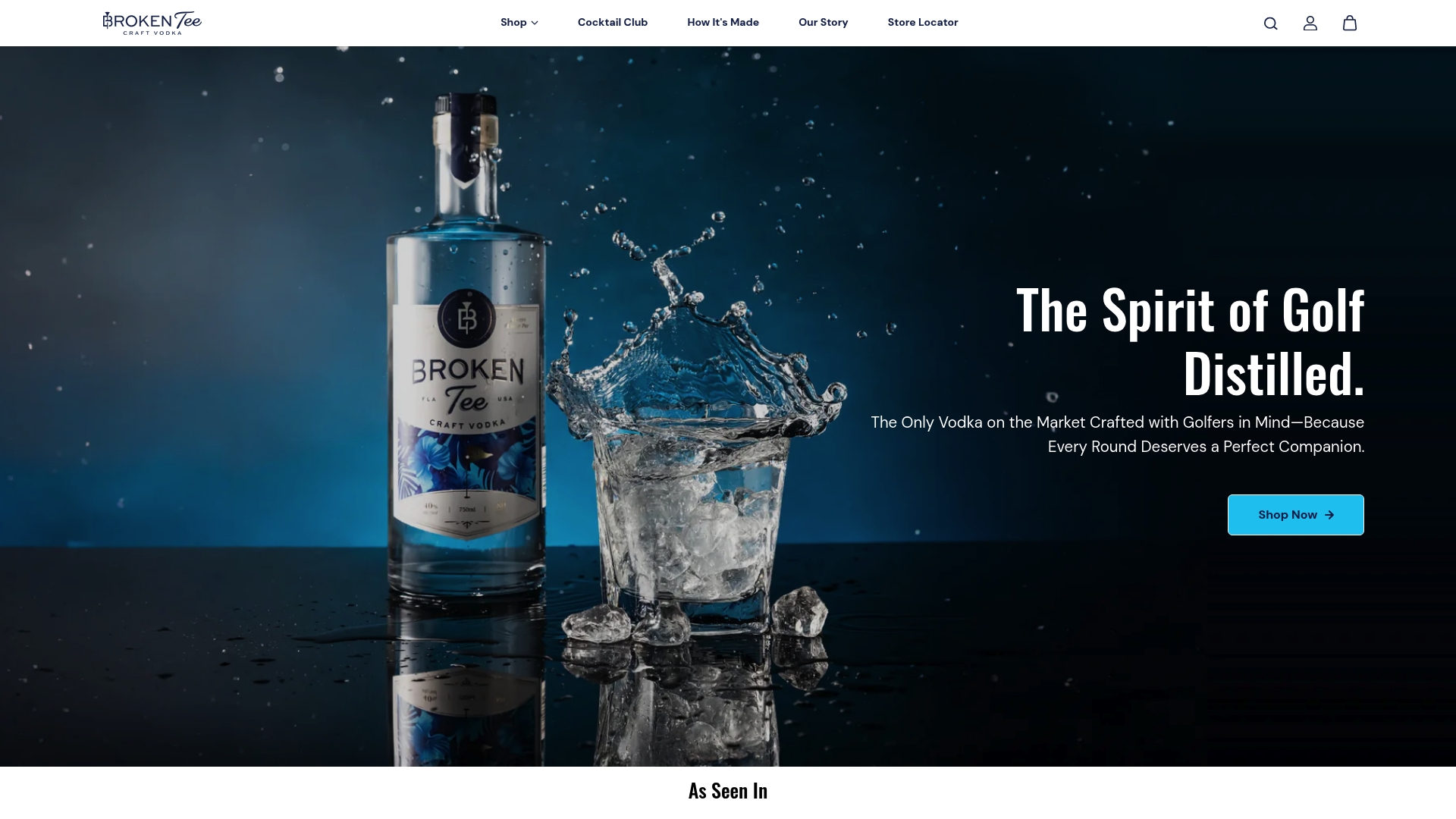
New here? Check the new customer offer, and pair your bottle with a hat, glass or tee from our golf merch collection. Running a club bar or event? Learn why Broken Tee fits the golf crowd.
FAQ
Does vodka have additives?
Sometimes. Federal rules let vodka be treated with up to 2 grams per liter of sugar and 1 gram per liter of citric acid and still be labeled vodka. Industry sources also report honey and glycerine in some bottles. Labels aren’t required to list ingredients, so a brand’s own explanation of its process is your best guide.
Is “additive-free” an official label?
No. TTB doesn’t define it, so any brand can use the phrase. Independent groups exist, but the Additive Free Alliance says it is not a regulator or an official certification. Use these claims as a prompt to read about how a vodka is made.
What is the cleanest vodka you can buy?
There’s no official ranking for “clean.” Look at the facts you can compare: the base grain, the number of distillations, the filtration method and whether the label is plain “vodka” rather than flavored. Then taste it chilled and neat and go with the one you like best.
Does additive-free vodka taste different?
It can, but the base spirit and refinement matter most. The Virginia ABC describes well-made premium vodka as smooth and mellow without harsh or medicinal notes. Taste two bottles side by side, chilled, to find your own favorite.
Sources
- Difford’s Guide: Vodka Production, Common Additives Explained
- Difford’s Guide: Vodka Definition
- eCFR: 27 CFR 5.142, Neutral spirits or alcohol
- eCFR: 27 CFR Part 5, Labeling and Advertising
- TTB Ruling 56-98
- TTB Ruling 97-1
- Federal Register, December 29, 1994
- TTB Distilled Spirits Example Formulas
- TTB Distilled Spirits Formulas and Labels chart
- Virginia ABC: Buying Guide for Vodka
- National Consumers League petition to TTB, February 2019
- VinePair: Additive Free Alliance relaunches as nonprofit
- Armen’s Barrel: Additives in Vodka
- Compound Chemistry: The Chemistry of Vodka
- Golf.com: 3 rules for drinking on the course


